

RESOURCES
Helpful Information About Potential Welding Careers & Trucking Jobs
Check out this selection of articles below to learn more about career choices and how to prepare for in-demand job opportunities.
-

Spot scams, protect accounts, and explore a new career.
October is Cybersecurity Awareness Month. It is a good time for everyone to check how safe their phones, email, and bank accounts really are. Online crime is not just a problem for big companies. In 2025, the FBI received more than 1 million complaints about internet crime, and reported losses topped $20.8 billion. Many of those victims were regular people who clicked a link, answered a call, or trusted the wrong message. This article covers what Cybersecurity Awareness Month is, why it matters for everyday people, which scams to watch for, and simple steps anyone can take to stay safer online.What is Cybersecurity Awareness Month?
Cybersecurity Awareness Month started in 2004. It is led by the National Cybersecurity Alliance and the Cybersecurity and Infrastructure Security Agency (CISA). The goal is to teach people and businesses how to protect themselves online. 2026 marks the campaign's 23rd year. The National Cybersecurity Alliance's theme this year is "Don't Make It Easy for Them." The idea is simple. Small habits, repeated every day, make it harder for criminals to steal money and personal information.Why Cybersecurity Matters for Everyday People
Many people think hackers only go after large companies. In reality, individuals are common targets because they often reuse passwords and trust messages that look real. One stolen password can lead to drained bank accounts, identity theft, and damaged credit. Fixing that damage can take months. The numbers show how common online crime has become. According to the FBI's 2025 Internet Crime Report:- Americans filed 1,008,597 complaints about internet crime.
- Reported losses reached $20.877 billion, up 26% from 2024.
- Phishing and spoofing were the most reported crimes, with 191,561 complaints.
- For the first time, the report tracked scams that used artificial intelligence (AI). Those scams led to 22,364 complaints and about $893 million in losses.
Common Scams to Watch For
Scammers change their methods often, but most attacks fall into a few familiar groups.- Phishing emails and texts. These messages look like they come from a bank, a delivery company, or an employer. They ask the reader to click a link, "verify" an account, or pay a small fee.
- Spoofed phone calls. Caller ID can be faked. A scammer may claim to be from a bank, a government agency, or tech support and ask for account details.
- AI voice and video scams. Criminals can copy a person's voice from short clips posted online. They then call a family member and ask for money in an "emergency."
- Fake job offers. Some job posts are traps. Red flags include requests for bank information before hiring or upfront payments for training or equipment.
- Investment and cryptocurrency scams. These promise fast, "guaranteed" returns. Investment fraud caused the largest losses in the FBI's 2025 report, at about $8.6 billion.
Simple Steps to Stay Safe Online
Good online safety does not require technical skills. A few basic habits block most common attacks.- Use strong, unique passwords. A long passphrase is harder to crack than a short, complex password. Each account should have its own password, and a password manager can keep track of them.
- Turn on multi-factor authentication (MFA). MFA adds a second step, like a code sent to a phone, when someone logs in. Even if a password is stolen, MFA can stop a criminal from getting in.
- Keep devices updated. Software updates often fix security holes. Turning on automatic updates for phones, computers, and apps is one of the easiest ways to stay protected.
- Pause before clicking. When a message seems urgent, it is best to contact the company directly. That means using its official app, website, or the phone number on the back of a card, not the link or number in the message.
- Set a family code word. A shared word that only family members know can help confirm a real emergency call. This simple step can help stop AI voice scams.
- Limit what is shared online. Birthdays, pet names, and hometowns are common security question answers. Keeping social media profiles private makes this information harder to find.
- Length: 32 weeks and 720 clock hours.
- Format: Distance education through the Visalia campus or a hybrid format at the Las Vegas campus.
- Training: Students start with computer and office basics, then move into ethical hacking, security monitoring, digital forensics, and network defense. Hands-on labs take place in safe, isolated environments.
- Certification prep: Coursework aligns with CompTIA Security+, Certified Ethical Hacker (CEH), and Computer Hacking Forensic Investigator (CHFI).
- Real-world experience: Students complete a 135-hour externship before graduating.
-
Bringing IT Certification Training to Students
Advanced Career Institute now offers CompTIA certification training. This is an industry-leading program for IT skills in the technology sector. These courses are offered online for California residents. Designed to encourage more California residents to enter technology careers, our family-owned trade school added these online courses through this partnership to help them get their IT certifications. Advanced Career Institute has brought trade school programs to the Central Valley California and Las Vegas areas for decades. By adding certifications to the school’s hands-on career training programs for students statewide, ACI gives students more valuable training that leads to steady IT careers. The CompTIA IT certification courses provided with ACI give professionals a real path into IT careers, The program covers:- CompTIA A+
- Network+
- Security+
- Cloud+
What You Need to Know
- Advanced Career Institute partners with CompTIA to bring top-tier IT certifications
- Students can study at their own pace online without strict class times
- Technology jobs keep growing, especially in cybersecurity and network support, creating thousands of open positions
What is Advanced Career Institute's New CompTIA Partnership?
The Partnership with CompTIA
Advanced Career Institute recently expanded its training options to include online CompTIA certification courses for California residents. The family-owned trade school, known for its practical approach to CDL and welding training across Central Valley California and Las Vegas, now offers IT certification programs throughout the state of California. This partnership brings CompTIA certification courses directly to students through an online format designed for working adults. For ACI, this partnership marks a significant expansion into the technology sector, adding an online component to their traditional in-person trade programs. Students can now pursue CompTIA’s industry-recognized IT certifications. The flexible online programs allow them to study while managing life commitments, without leaving their current jobs or relocating to attend classes.Who Are the Partners Involved?
Advanced Career Institute partnered with CompTIA, the world’s leading tech association, to deliver these certification courses online. CompTIA has been the standard for IT certifications for over 40 years, with more than 2 million IT professionals certified worldwide. Their certifications are vendor-neutral, meaning they’re recognized across the entire technology industry rather than tied to one specific company. The trade school maintains its focus on practical, results-oriented education while expanding into the technology sector. Students receive the same quality training approach that Advanced Career Institute has delivered for decades in their CDL and welding programs. CompTIA was the natural choice because their certifications open doors to real IT jobs. Employers across industries recognize CompTIA credentials as proof that someone has the skills to do the work.Why This Partnership Matters
This partnership addresses the growing demand for qualified IT professionals across California. Traditional certification training often requires expensive programs with rigid schedules that don't work for people with jobs or family responsibilities. Advanced Career Institute's approach removes these barriers by offering flexible online learning at accessible prices. The partnership fits with Advanced Career Institute's mission of providing practical career training that leads to stable employment. IT professionals with CompTIA certifications can find steady work with room for growth, making these courses a natural addition to their program offerings.What Does This Mean for IT Career Training?
Growing Demand for IT Professionals
The technology sector keeps growing, which means more job openings in cybersecurity, network support, and technical help desk roles. Companies need people with CompTIA certifications, but finding qualified works can be a challenge. The U.S. Bureau of Labor Statistics shows computer support jobs will continue to be a necessity. Cybersecurity positions are growing even faster. This creates real opportunities for people looking to change careers or find stable work with the skills employers actually want.Making Certifications More Accessible
IT certification training used to be expensive, with set schedules that didn't work for working adults. Online CompTIA courses fix these problems. Students can learn from home and study when it works for their schedule. They don't need to quit their jobs or move somewhere else. This helps people in Central Valley California and other areas who couldn't access training before. Working parents and people with other responsibilities can now get certified. Advanced Career Institute's online approach connects students to good-paying tech opportunities without the usual barriers.Conclusion
Advanced Career Institute's new partnership with CompTIA addresses critical needs in California's IT workforce by making professional certifications accessible and affordable. The online format removes traditional obstacles like geographic limitations and inflexible schedules, benefiting working adults and underserved communities. This expansion connects qualified California candidates with thousands of open positions requiring CompTIA credentials and a stable career for the future.FAQs
Are CompTIA courses recognized by employers in the IT industry?
CompTIA certifications are widely recognized by employers across the technology sector. These industry-standard credentials demonstrate proficiency in essential IT skills and are often listed as requirements or preferred qualifications for positions in technical support, network administration, and cybersecurity roles.What IT certification programs are available through Advanced Career Institute?
Advanced Career Institute offers several IT certification training programs including:- CompTIA A+
- CompTIA Network+
- CompTIA Security +
- CompTIA Cloud+
What makes CompTIA certifications valuable for career changers?
CompTIA certifications open doors to stable, high-paying technology careers with strong job growth projections. The IT sector faces a significant gap between available positions and qualified candidates, especially in cybersecurity and network administration, making certified professionals highly sought after by employers. -

What the pay, demand, and AI data actually show
IT support remains one of the fastest ways into a technology career that pays well and doesn't require a four-year degree. A high school diploma plus the right certifications is enough to get hired, and from there the path opens into network administration, cybersecurity, and cloud computing, fields where pay climbs well into six figures. Here's what the data says about getting started now. Key Takeaways- Computer and information technology occupations overall are projected to grow faster than average, adding about 280,000 openings a year through 2035, according to the Bureau of Labor Statistics.
- About 48,700 IT support openings come open every year as people retire or move into other roles, in a field of more than 900,000 workers nationwide.
- Computer network support specialists earn a median of $76,220 a year, well above the overall support specialist median of $62,890.
- Information security analysts, a common next step after IT support, are projected to grow 21% from 2025 to 2035, with a median salary of $129,180.
- A four-year degree is not required. Many computer support specialists qualify with a high school diploma plus IT certifications, according to the BLS.
How Much Demand Is There for IT Support in 2026?
The numbers here are strong for anyone looking to get hired. The Bureau of Labor Statistics projects about 48,700 openings for computer support specialists every year through 2035, all from normal turnover as people retire or move up into other IT roles. In a field this size, that turnover alone creates a steady, dependable stream of entry points for new graduates. Zoom out and the picture gets even better. Across all computer and information technology occupations, including cybersecurity, cloud computing, and systems administration, the BLS projects growth faster than the average for all U.S. jobs, with roughly 280,000 openings a year through 2035. Some routine helpdesk tasks like password resets are shifting to automated tools, which is part of why the support specialist category itself is projected to hold close to flat rather than expand. That shift is exactly why the entry-level role works best as a launchpad. It gets someone in the door and building real experience fast, before they specialize into one of the roles driving that broader growth.Will AI Replace IT Support Jobs?
No, and the data on what's actually growing around IT support backs that up. AI handles the simplest, most repetitive requests now, things like password resets and basic connectivity fixes. That frees up support technicians to spend their time on the problems that actually require a person: troubleshooting that needs judgment, security concerns, and situations where a user needs someone to ask the right follow-up question. This is exactly why the field is evolving into something better, not disappearing. Industry researchers describe this as a redesign of entry-level IT roles rather than their elimination. The technicians who do well are the ones who understand why a fix works, not just how to follow a script, and that kind of skill is exactly what certification training and hands-on labs are built to develop.What Does IT Support Actually Pay?
Pay climbs quickly with specialization, and knowing the ladder helps set expectations from day one. Computer user support specialists, the most common entry point, earned a median of $61,860 a year as of May 2025, with top earners clearing $100,540. Computer network support specialists earned more, a median of $76,220, with the highest-paid reaching $127,780. Industry makes a difference too. Support specialists working in government earned a median of $77,180 in 2025, notably above the field-wide average. Roles in finance and insurance also paid above the median. The bigger jump comes with specialization, and it's a fast one. Information security analysts, a natural next step after a few years in support, earned a median of $129,180 in 2025. Network and computer systems administrators earned a median of $99,130. Both roles typically start with the same foundation: a support role, paired with the right certifications.The Real Career Path: Support Is the Starting Line
The reason IT support works so well as a first move is what comes after it. Help desk and support roles exist everywhere, since every organization with computers needs someone to call when something breaks. That constant, universal demand is what makes it the lowest barrier to entry in tech, and the troubleshooting experience gained there transfers directly into higher-paid specialties. From there, the paths split toward strong growth. Some technicians move into network administration, maintaining systems instead of just fixing user problems. Others move toward cybersecurity, one of the strongest growth areas in all of technology. Information security analyst jobs are projected to grow 21% between 2025 and 2035, adding more than 40,000 positions nationally, driven by rising cyberattacks and the security demands of AI adoption itself. Cloud computing is another fast-growing lane, as more companies shift infrastructure off physical servers. The certifications that open these doors build on each other. CompTIA A+ gets a foot in the door for that first support job. Network+ and Security+ point toward the higher-paying specialties from there. This is the structure behind ACI's IT Professional Training program, which prepares students for A+, Network+, Security+, and Cloud+ certifications in sequence, building toward a career rather than a single job title.How to Get Started in IT Support
Breaking in is faster and more accessible than most people expect.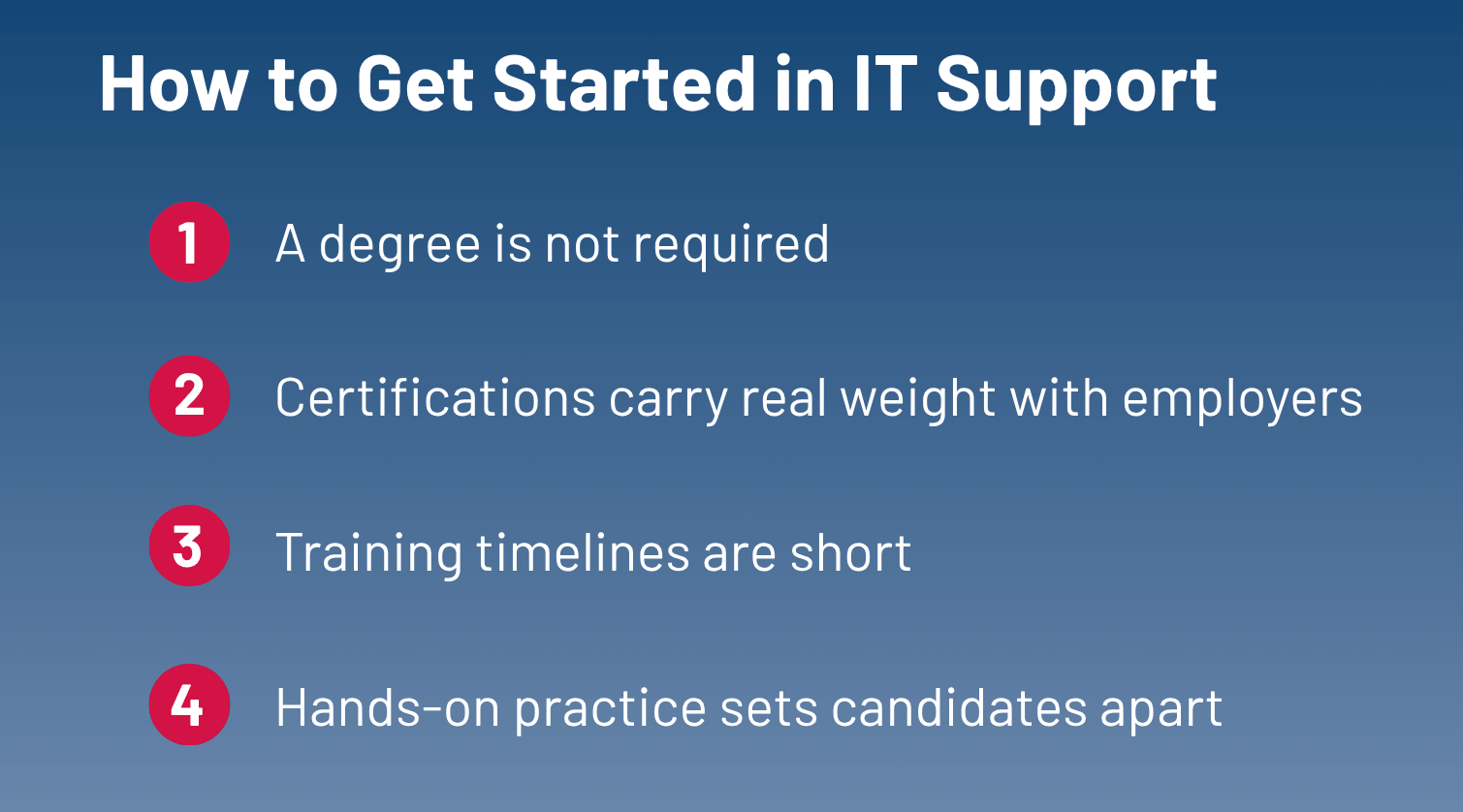 A degree is not required. The BLS confirms that computer user support specialists typically need some college coursework, but candidates can qualify with a high school diploma plus relevant IT certifications.
Certifications carry real weight with employers. CompTIA A+ is the standard entry-level credential, and it shows up in more than 200,000 U.S. job listings each year. It covers hardware, operating systems, networking basics, and troubleshooting, the exact mix of skills a help desk job requires on day one.
Training timelines are short. A focused certification program can be completed in months, not years. ACI's IT program runs 8 to 12 months depending on the program, fully online, and includes an IT externship for eligible students to build real, hands-on experience before graduating.
Hands-on practice sets candidates apart. Employers increasingly want to see proof of real troubleshooting, not just a passed exam. Even a small portfolio of solved problems from practice labs helps a candidate stand out.
Advanced Career Institute's IT Professional program, delivered through a partnership with CompTIA, is built around this exact path: A+, Network+, Security+, and Cloud+ certifications, 32 to 48 weeks, fully online for California residents. Tuition assistance is available for students who qualify, and ACI's job placement team supports graduates as they enter the field.
A degree is not required. The BLS confirms that computer user support specialists typically need some college coursework, but candidates can qualify with a high school diploma plus relevant IT certifications.
Certifications carry real weight with employers. CompTIA A+ is the standard entry-level credential, and it shows up in more than 200,000 U.S. job listings each year. It covers hardware, operating systems, networking basics, and troubleshooting, the exact mix of skills a help desk job requires on day one.
Training timelines are short. A focused certification program can be completed in months, not years. ACI's IT program runs 8 to 12 months depending on the program, fully online, and includes an IT externship for eligible students to build real, hands-on experience before graduating.
Hands-on practice sets candidates apart. Employers increasingly want to see proof of real troubleshooting, not just a passed exam. Even a small portfolio of solved problems from practice labs helps a candidate stand out.
Advanced Career Institute's IT Professional program, delivered through a partnership with CompTIA, is built around this exact path: A+, Network+, Security+, and Cloud+ certifications, 32 to 48 weeks, fully online for California residents. Tuition assistance is available for students who qualify, and ACI's job placement team supports graduates as they enter the field.
FAQs
Will AI take over IT support jobs?
No. AI is automating the simplest, most repetitive tasks like password resets, which frees up technicians to focus on the complex troubleshooting and security work that still requires a person.Do you need a college degree to work in IT support?
No. Many computer support specialists qualify with a high school diploma plus relevant IT certifications, according to the BLS.What is the difference between IT support and cybersecurity?
IT support focuses on fixing hardware, software, and network problems for users, while cybersecurity focuses on protecting systems from attacks. Cybersecurity roles typically pay more than double the entry-level support median, and support experience is a common stepping stone into them.Can an IT support job lead to a higher-paying career?
Yes. Many people use support roles to gain hands-on experience before moving into network administration, cybersecurity, or cloud computing, all of which pay significantly more than entry-level help desk work.What certification should someone earn first for IT support?
CompTIA A+ is the standard starting certification and appears in over 200,000 U.S. job listings a year, making it the strongest first step toward a support role and the specialties beyond it. -

For the Miles You Drive and the Sacrifices You Make
National Truck Driver Appreciation Week runs from September 13 to 19, 2026. This is the 38th year of putting the spotlight on the men and women who keep our country moving, and this year's theme is "For the Miles You Drive and the Sacrifices You Make." Professional drivers haul about 11 billion tons of freight every year, which makes up more than 70 percent of all freight tonnage moved in the United States. Almost every product in a California home or business, from groceries to building materials, spent part of its trip on a truck. That theme points to something worth recognizing: the commitment it takes to do this job well. For someone driving through California, that commitment looks like a specific set of skills, most of which never make it into a thank-you post.What It Takes to Drive in California
Driving professionally in California means being ready for conditions other states do not have. Central Valley summers regularly push past 100 degrees, and drivers train to manage that heat safely for themselves and their equipment. Routes heading south often include the Grapevine on Interstate 5 or Tehachapi Pass, both known for steep grades and quick weather changes, which is exactly the kind of driving that CDL training is built around. Near the ports of Los Angeles and Long Beach, the busiest port complex in the country, drivers learn to navigate heavy traffic and tight scheduling as a normal part of the job. In recent years, that has also meant knowing how to adjust when wildfire smoke or a sudden route closure changes the plan. Handling all of this well is a real skill, and it is a big part of why professional drivers earn the respect this week is built around.The Sacrifice Behind the Harvest
California's Central Valley produces a large share of the nation's fruits, vegetables, and nuts. That food does not get from the field to the store on its own. Drivers hauling agricultural freight work around harvest schedules, which calls for early mornings, tight delivery windows, and careful handling of loads that cannot wait a day. This is one of the more specialized parts of the industry, and it is also personal for ACI. The Ag Transportation program trains drivers specifically for this work, and the school's campuses in Fresno, Las Vegas and Visalia help ensure that training is available.Time at Home, and the Choice to Protect It
Time at home matters to most drivers, and today's driving careers offer more ways to protect it than people often expect. Regional and local routes exist alongside over-the-road positions, and many drivers build a career around routes that get them home on a predictable schedule. Choosing the right fit is part of starting off on the right foot. ACI's job placement team works with trucking partners across route types, so graduates can choose the balance of home time and miles that fits their life, rather than assuming long-haul is the only path forward.The Decision to Become a Driver
There is another kind of commitment worth recognizing during this week, and it belongs to the person reading this post while considering a career change. Choosing to go back to school and start a new career takes real motivation. It is one of the clearest ways someone can take charge of their future, and it is often the first step toward the kind of stability and independence this profession can offer. That step is easier with the right support in place. Tuition assistance and grants and scholarships help make training affordable, and veterans transitioning out of the military have a program built around their benefits. None of it changes how big the decision is, but it does mean no one has to make that decision alone.Honoring the Week
National Truck Driver Appreciation Week is one week out of the year, but the skill and commitment it celebrates are built every day, on California highways, through Central Valley fields, and in the choices drivers make to balance the road with life at home. ACI's Class A CDL Training program prepares the next generation of drivers for this work with the skills and confidence it deserves. Anyone considering this career can contact ACI to talk through what training and the road ahead actually look like. -

A look at current pay, hiring trends, and top-paying jobs in California
Key Takeaways California's welding labor market in 2026 combines strong demand, above-average pay, and multiple training pathways. Here are the core points for anyone weighing this career.- California employs about 26,060 welders. Their median wage is $58,060 a year, about 8% above the national median of $53,750, according to the latest BLS data (May 2025).
- A wave of retirements is opening 40,300 jobs each year across the country. The average welder is 56 years old, and most welders retire around age 57, per AWS workforce data.
- Experience and specialty training raise pay by a lot. Welder IV workers earn close to $80,000 a year. Welding Inspectors and Engineers can earn $90,000 to $110,000.
- Aerospace, high-speed rail, and renewable energy are the top hiring fields in California. All three pay above-average wages and offer long-term work.
- Industry and specialization matter as much as experience. Pay can swing by up to 65% between the highest- and lowest-paying fields, and certified inspectors and engineers can earn $90,000 to $110,000.
How Many Welding Jobs Are There in California in 2026?
"Really, what's being said is we don't need just more skilled workers. We need an army of skilled workers to do what's coming." — Brian Huff, Owner and CEO, Midwest Technical Institute
California's welding workforce is bigger than most people think. The 2026 data backs this up. The state ranks among the top employers of welders in the country, and that has not changed.National Welding Employment and the Retirement Wave
The United States employs about 416,210 welders, cutters, solderers, and brazers, according to the latest BLS data from May 2025 [1]. The wider welding workforce, which includes related jobs, reached about 771,000 people as of 2025, per the American Welding Society [2]. A wave of retirements is pushing demand higher. The average welder in the U.S. is 56 years old, and most welders retire around age 57. That gap, combined with high schools cutting welding programs over the years, has created a shortage.California's Share of the Welding Workforce
California employs about 26,060 welders, one of the largest welding markets in the country, behind Texas [1]. The Los Angeles-Long Beach-Anaheim metro area reports a median welder wage of $56,160 a year [1].Why Annual Openings Outpace the Slow Growth Rate
The BLS expects welding jobs to grow just 2% from 2025 to 2035, which is slower than average [3]. But that number alone does not tell the full story. About 40,300 welding jobs open up each year, mostly from retirements and workers leaving the field [3]. The AWS projects 320,500 total openings in the years ahead [2]. Job counts are only part of the story. Pay matters just as much.What Do Welders Earn in California Compared to the National Average?
Pay is one of the most useful things to know before choosing this career. The gap between national wages and California's numbers is big enough to change how someone weighs this path.National Median Salary vs. California Salary by Metro Area
The national median salary for welders is $53,750 a year, based on the latest BLS data from May 2025 [1]. California's median annual wage is $58,060, about 8% above the national figure [1]. U.S. News reported a 2024 median of $51,000, which shows how fast pay has climbed in just one year [4]. Welders in the San Francisco-Oakland-Fremont metro area earn a median of $64,320 a year. Welders in the Los Angeles area earn a median of $56,160 [1].Salary by Experience Level: Welder I Through Welder IV
Experience raises pay by a lot in California, according to August 2026 estimates. Top earners at the Welder II level make $72,866 a year [5]. Welder IV workers earn a fair amount more.Level Experience Avg. Annual Salary Welder I 0-1 years $49,998 Welder II 1-3 years $61,839 Welder III 3-5 years $69,756 Welder IV 5-7 years $79,567 How Specializations Affect Pay
The industry a welder works, as well as the welding certifications they earn, in can change pay by as much as 65% between the highest- and lowest-paying fields [6]. Aerospace and defense, energy and utilities, and software and networking companies pay 10% to 20% above average [5]. Certified Welding Inspectors (CWI) earn $70,000 to $90,000 a year, and senior inspectors in aerospace or oil and gas can earn more than $95,000 [7]. Senior welding engineers earn $110,000 or more [8].California Cost of Living and What Higher Wages Actually Mean
California's higher wages need to be weighed against its cost of living. A Welder I earning $49,998 in California takes home about the same as a Welder I in Washington, D.C., who earns $50,188 [6]. Anyone weighing this career should compare regional pay to local housing and transportation costs. This matters most in the Central Valley, where living costs are lower than coastal cities but welding jobs stay strong. Certain California industries pay welders more than the average numbers suggest. The industry matters as much as the paycheck itself.Which California Industries Are Hiring Welders in 2026?
California's economy covers many industries, and that mix is one reason welder demand here looks different from most other states.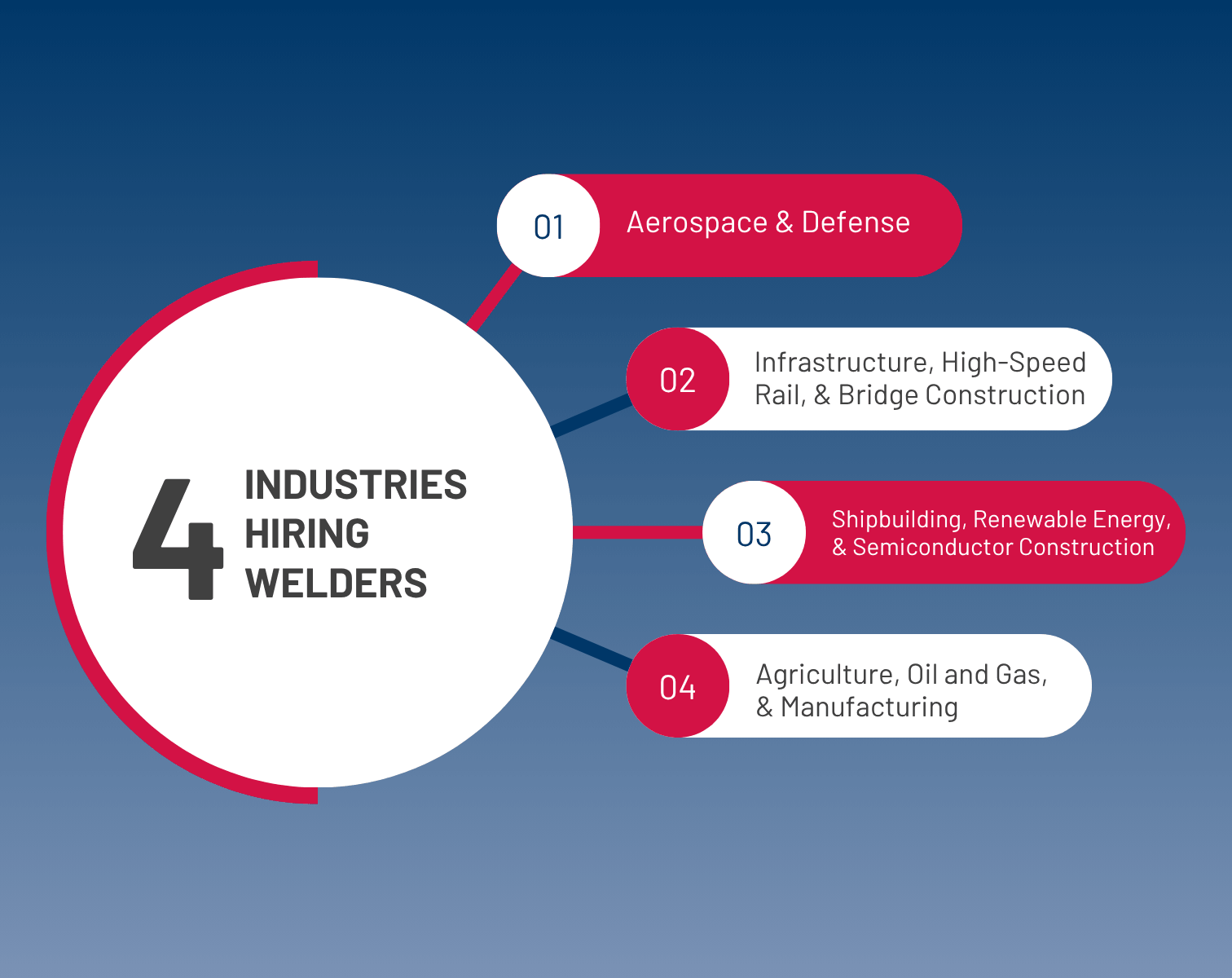
Aerospace and Defense in Southern California
Fabrication shops in Southern California look for welders skilled in GMAW (MIG) and GTAW (TIG) welding. They work with steel, stainless steel, aluminum, and titanium. Many of these jobs require International Traffic in Arms Regulations (ITAR) compliance and experience with aerospace processes [9]. Aerospace and defense jobs pay about 10% above the average welder wage [5].Infrastructure, High-Speed Rail, and Bridge Construction
California's high-speed rail project has created more than 19,000 jobs in the Central Valley. It keeps demand steady for steel workers, iron workers, and welders [10]. The City of Long Beach, for example, is hiring pipeline welders at $36.08 to $49.03 an hour, and the job requires special certifications [11].Shipbuilding, Renewable Energy, and Semiconductor Construction
Port operations along California's coast keep demand steady for structural and pipe welders. Renewable energy projects and new semiconductor factories are creating welding jobs that few other states can match.Agriculture, Oil and Gas, and Manufacturing in the Central Valley
The Central Valley includes Fresno, Visalia, and Bakersfield. It mixes agriculture, oil and gas, and manufacturing into one regional economy, and welding skills cross all three industries here. That mix keeps demand steady across sectors rather than tied to any single employer type.How 2026 Tariffs Affect California Welding Shops
New tariffs on steel and aluminum in 2026 are changing material costs for fabrication shops across the state. Welders and shop owners should plan for these added costs, especially on fixed-price contracts. Knowing which industries are hiring helps explain not just where the jobs are, but where the better pay is. That difference becomes even clearer when looking at how pay grows over the course of a welder's career.Career Growth and Specialization Options for California Welders
A welding certificate qualifies graduates for entry-level jobs. Specialty skills are what separate entry-level pay from the top of the pay scale.Entry-Level to Senior Welder
The jump from Welder I at $49,998 to Welder IV at $79,567 is a 59% pay increase over about 5 to 7 years [6]. Certifications and specialty training speed up that jump.High-Paying Paths
Welding Inspectors (CWI) start at $50,000 to $65,000, and experienced inspectors can earn $90,000 or more [7]. Welding Engineers start at $65,000 to $80,000, and senior roles reach $110,000 or higher [8]. Robotic welding is a growing field as more manufacturers automate their production lines. The ceiling for welding careers is higher than most people expect, and the pay data backs it up at every stage, from entry-level shop work to inspection, engineering, and ownership. For welders in California weighing where to start, Advanced Career Institute's welding program is worth a look, with campuses in Visalia, Fresno, and Bakersfield.FAQs
Does welding pay well in California?
Yes. California's median annual wage for welders is $58,060, about 8% above the national median of $53,750. Pay climbs fast with experience, reaching $79,567 for Welder IV and $70,000 to $90,000 for Certified Welding Inspectors.Is welding growing or declining?
Welding jobs are projected to grow just 2% from 2025 to 2035, but about 40,300 openings appear each year nationally due to retirements. Demand stays strong even though the growth rate looks modest.Why are there thousands of welding job openings each year if job growth is only 2%?
Most of those openings come from retirements, not new positions. The average welder is 56 years old, and about 40,300 jobs open up nationally each year as the current workforce ages out.How long does it take to go from entry-level to top pay as a welder in California?
Most welders move from Welder I to Welder IV in about 5 to 7 years, a jump from $49,998 to $79,567. Certifications and specialty training can speed that timeline up.Does the industry a welder works in change how much they can earn?
Yes. Pay can swing by up to 65% between the highest- and lowest-paying industries, with aerospace, defense, and infrastructure work paying well above average.What career paths lead to the highest welding salaries?
Certified Welding Inspectors earn $70,000 to $90,000, senior welding engineers earn $110,000 or more, and some welders open their own fabrication shops. Business ownership and technical specialization pay the most over time. References[1] – https://www.bls.gov/oes/current/oes514121.htm
[2] – https://weldingworkforcedata.com/
[3] – https://www.bls.gov/ooh/production/welders-cutters-solderers-and-brazers.htm
[4] – https://careers.usnews.com/best-jobs/welder/salary
[5] – https://www.salary.com/research/salary/benchmark/welder-ii-salary/ca
[6] – https://www.salary.com/research/salary/benchmark/welder-i-salary/ca
[7] – https://www.aws.org/career-resources/career-paths-in-welding/welding-inspector/
[8] – https://www.aws.org/career-resources/career-paths-in-welding/welding-engineer/
[9] – https://www.indeed.com/q-aerospace-welding-l-orange-county,-ca-jobs.html
[10] – https://hsr.ca.gov/work-with-us/jobs/
[11] – https://www.governmentjobs.com/careers/longbeach/jobs/5378854/pipeline-welder-layout-fitter
-
Part 1: Your Guide to Becoming a Truck Driver
The question comes up often: with automation, a changing economy, and shifting job markets, is truck driving still worth it as a career? The short answer is yes. Here is what the numbers actually show. Trucking is not just holding on in 2026. In several real ways, conditions for new drivers are getting better. Companies are working harder to hire and keep qualified drivers. Pay packages are improving. And the technology coming into modern trucks is making the job safer and easier to manage. For someone thinking about a career change or a first career, now is the best time to get in.There is Strong, Consistent Demand for Qualified Drivers
One of the best reasons to enter trucking right now is simple: the industry needs drivers, and that need is not going away. The Bureau of Labor Statistics projects about 237,600 job openings for heavy truck drivers every year through 2034. Most of those openings come from retirements and turnover. A driver who earns a CDL today is stepping into a market with a steady, documented need for qualified people. The American Trucking Associations projects a shortage of roughly 82,000 drivers by end of 2026, with that number expected to grow past 160,000 by 2031 if hiring trends do not change. A large share of those openings exist because turnover at major carriers has historically run above 90 percent per year. That is not a sign of a bad industry. It is the reason carriers have started competing harder for drivers who stay, investing in better pay, better equipment, and better working conditions to keep them.Pay Is Competitive, and Getting Better
The median pay for heavy and tractor-trailer truck drivers was $57,440 per year as of May 2024, according to the BLS. The bottom 10 percent earned less than $38,640. The top 10 percent earned more than $78,800. Most first-year drivers earn between $50,000 and $60,000 per year. That range moves up quickly with experience, clean safety records, and added endorsements. Pay is also changing in other ways. Many carriers are moving away from paying only by the mile. In 2026, more companies are building pay packages that include bonuses for safety, performance, and retention. Health coverage and retirement benefits are becoming more common too. This shift is a direct result of companies competing for qualified drivers. Drivers who earn extra endorsements, such as hazmat, tanker, or flatbed, can move into higher-paying freight. With experience and the right endorsements, over-the-road drivers at strong carriers often earn between $65,000 and $90,000 per year. Some specialized positions, typically reached after several years on the road, go above $100,000.Technology Is Improving the Job, Not Eliminating It
A lot of people thinking about trucking in 2026 want to know one thing: will self-driving trucks take this job away? The data says no, at least not soon. Research shows that heavy truck drivers have just 10 percent AI exposure. That is one of the lowest rates among all 500 job types studied. And as of 2026, no state allows fully driverless commercial trucks on all road types. What technology is doing is making the job better. Modern trucks now come with driver assistance tools that reduce fatigue and improve safety. Better cab designs make long shifts more comfortable. These tools help drivers do their job. They do not replace them. Trucking is also much more than driving. Drivers secure loads, work with warehouse staff, manage paperwork, and handle problems on the road. Those tasks need human judgment and physical skill. Current automation cannot handle the full range of situations a driver faces every day.Carriers Are Working Harder to Keep Drivers
High turnover has pushed carriers to rethink how they treat drivers. Replacing a driver costs far more than keeping one, and companies have started to act on that math. In 2026, more carriers are investing in driver well-being. That means better equipment, more predictable schedules, and clearer pay structures. Many are also making pay easier to understand, which was a long-standing frustration in the industry. For a new driver, this matters. A company that is focused on keeping drivers is more likely to support new hires, offer real onboarding, and provide a clear path to better pay over time.The Career Path Has Real Room to Grow
Trucking is not one job. It is a career with real room to grow. A driver who starts on a local route can move into regional or long-haul driving for higher pay. Extra endorsements open the door to tanker, flatbed, refrigerated, and hazmat freight, all of which pay more. Experienced drivers can also move into dispatch, training, fleet management, or run their own operation as an owner-operator. The workforce is also more diverse than most people expect. Women now make up about 14 percent of all truck drivers as of 2025. That number has been growing as more carriers actively recruit women into the profession. Veterans, career changers, and people who do not want a four-year degree are all well-represented in trucking. A CDL takes weeks to earn, not years. Financial help is available at many accredited programs, including grants, scholarships, and veterans benefits.What Does Getting Started Actually Look Like?
In California and most other states, new CDL applicants must finish Entry-Level Driver Training through an FMCSA-registered school before taking their skills test. This is a federal rule. It means the CDL earned today comes with real, documented training behind it. Most CDL programs take three to seven weeks. They include classroom instruction and time behind the wheel of a commercial vehicle. Many schools also offer job placement help after graduation, connecting new drivers with carriers that are actively hiring.Frequently Asked Questions
Will self-driving trucks take over trucking jobs soon?
No, not in the near term. As of 2026, no state allows fully driverless commercial trucks on all road types. Research also puts truck drivers among the jobs with the lowest AI exposure, at just 10 percent.Can truck drivers earn six figures?
Yes, though not right away. Experienced over-the-road drivers and those with specialized endorsements regularly earn $65,000 to $90,000 per year. Some specialized freight positions go above $100,000.Is trucking a good career without a college degree?
Yes. A Class A CDL is a vocational credential earned in weeks. It qualifies drivers for jobs with a median wage of $57,440 per year, and the career offers real room to grow through endorsements and leadership roles.Is trucking a good career for women?
Yes. About 14 percent of truck drivers are women as of 2025, and that number is growing. Many carriers actively recruit women and offer programs to support them in the field. About Advanced Career Institute Advanced Career Institute offers Class A CDL training at campus locations in Visalia, Fresno, Merced, and Las Vegas. Tuition assistance and career placement support are available. Contact ACI to learn more about enrollment and program options.Sources Referenced
- S. Bureau of Labor Statistics, Occupational Outlook Handbook: Heavy and Tractor-Trailer Truck Drivers (May 2024) — www.bls.gov/ooh/transportation-and-material-moving/heavy-and-tractor-trailer-truck-drivers.htm
- Geotab, "Truck Driver Salary: 2025 Guide to Pay by State and Job Type" — geotab.com/blog/truck-driver-salary/
- Drive My Way, "Pay Trends for 2026 That Drivers Need to Know" (February 2026) — drivemyway.com/blog/pay-trends-for-2026-that-drivers-need-to-know/
- AI Changing Work, "Will AI Replace Truck Drivers? 2026 Data" (March 2026) — work/en/blog/will-ai-replace-truck-drivers
- America 1 Logistics, "Top Priorities for Truck Drivers in 2026: Safety, Pay, and Tech" (December 2025) — america1logistics.com/post/top-priorities-for-truck-drivers-in-2026-safety-pay-and-tech
- Linxup, "Trucking Industry Statistics" (October 2025) — linxup.com/blog/trucking-industry-statistics
- TransAm Carriers, "Trucking Prospects 2026: What Lies Ahead for the Industry" (January 2026) — transamcarriers.com/trucking-prospects-2026/
- FMCSA, Entry-Level Driver Training requirements — fmcsa.dot.gov/registration/training-providers
- Peak Transport, “Truck Driver Shortage 2026: What It Really Means for Job Seekers” peaktransport.co/blog/truck-driver-shortage-2026
- CDL Schools USA, “How Much Do New Truck Drivers Actually Make in 2026?” https://cdlschoolsusa.com/blog/cdl-first-year-salary-2026-reality-check