
Key Points to Consider
High school graduates need to weigh their options between trade school and college. Each path offers different financial outcomes and career opportunities that affect future earning potential and job stability.
- Trade school costs average $33,000 total vs college’s $270,811 investment, resulting in $10,000 vs $36,327 in student debt, respectively
- Skilled trades workers earn competitive salaries ($54,000-$95,000+) with faster job entry and 90% career satisfaction rates
- Trade jobs show strong growth (6-11%) and resist automation, while 42% of college graduates work in jobs not requiring degrees
- Trade school graduates achieve break-even within two years and deliver a $313,000 median ROI vs $160,000 for bachelor’s degrees
- Both paths lead to successful careers when aligned with personal interests, financial tolerance, and market demand for specific skills
The Shift Away from the Four-Year Degree
The trade school vs college debate continues to get attention. Today, 62% of white-collar workers say they would switch to skilled trades for better pay and job stability [1]. Student loan debt has passed $1.8 trillion, with borrowers carrying an average of $43,333 [2], and college costs have risen to $38,270 per year. At the same time, 42% of Gen Z workers are already in or pursuing trade jobs [3], and demand keeps growing as the U.S. faces a shortage of 300,000 electricians over the next decade [2]. For high school graduates weighing their options, understanding the trade school vs. college decision matters. This article covers costs, earning potential, job security, and career paths to help students choose the path that fits their goals.
Understanding the Difference Between Trade School and College
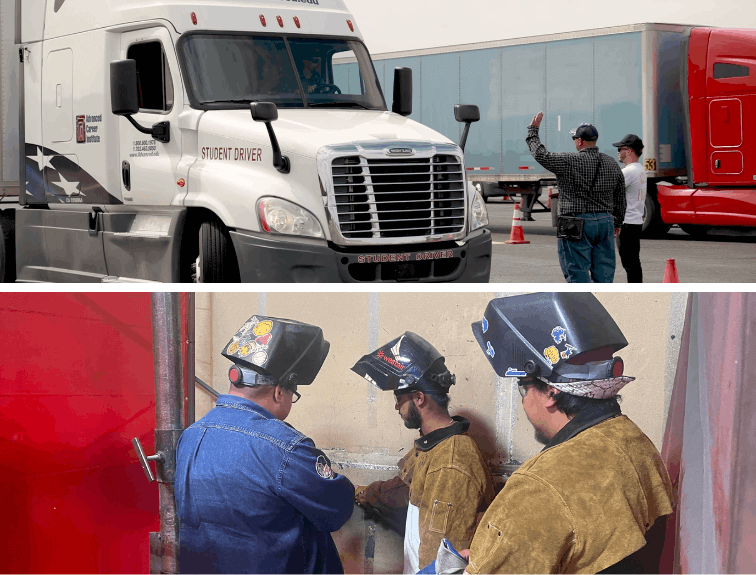
Trade schools, also called vocational or technical schools, teach job-specific skills through hands-on training. Programs cover fields like commercial driving, automotive technology, welding, IT, and electrical work. Most programs typically range from six months to two years, though some programs, like CDL training, take as little as four weeks to complete [3].
College programs are broader. Students take general courses in science, English, history, and math for the first year or two before focusing on a major. A bachelor’s degree takes four years to finish at the very least.
The two school types also differ in how courses are structured. Vocational education allocates 60% to practical training and 40% to classroom instruction. College programs are the reverse, with 60% academic learning and 40% hands-on experience through internships [4].
Trade schools skip the general education requirements to get students job-ready faster. Graduates earn diplomas or certificates and can start working or take licensing exams right away. Colleges award associate or bachelor’s degrees, which can lead to a wider range of career paths or further education. Trade school class sizes also tend to be smaller, while college courses often take place in large lecture halls [6].
Trade School vs College: Cost, Debt, and Financial Impact
Cost is one of the biggest factors students consider when choosing between trade school and college. Trade school students pay an average of $33,000 for the total program [5]. Most programs fall between $5,000 and $15,000 for common fields [7]. Specialized programs like aviation maintenance can exceed $30,000, while esthetician training typically costs $2,000 to $4,000 [5].
College costs are higher across the board. In-state public school students pay around $10,440 per year in tuition, or $21,950 per year with room and board. Out-of-state students pay $26,820 per year for tuition, or $38,330 with housing. Private school students pay $36,880 per year for tuition alone, or $49,879 with room and board [5].
The debt gap between the two paths is significant. Trade school graduates finish with an average of $10,000 in student loans, while college graduates carry $36,327 in debt after interest [8]. When tuition, fees, loan interest, and lost wages during school are included, a bachelor’s degree program can cost $270,811 total [9].
Trade school graduates also tend to see a higher return on their education costs. Trade certificates have a median ROI of $313,000, compared to $160,000 for bachelor’s degrees [10]. Most trade school graduates break even on their investment within two years of finishing school.
Earnings and Job Security for Trade School Graduates
Trade school graduates enter the workforce relatively quickly and at competitive pay. Trade school graduates earn an average of $67,000 in their first year [11]. Commercial truck drivers, for example, average $73,000 per year nationally [13]. Welders and IT support specialists follow similar patterns, with median pay ranging from $51,000 to $68,000 depending on the field and location [14] [15]. Earnings grow with experience, certifications, and specialization, and demand across these fields remains strong, with tens of thousands of positions opening each year.
The job market for recent college graduates has been more difficult. About 5.6% of college graduates between ages 22 and 27 are unemployed [9]. Additionally, 42% of college graduates work in jobs that do not require a degree [9]. College graduates with bachelor’s degrees had a 5.8% unemployment rate in early 2026, which was higher than that of workers without degrees during the same period [10].
The trucking industry is short an estimated 60,000 to 80,000 drivers, with the BLS projecting 5 to 6 percent job growth for heavy truck drivers over the next decade [16]. Welding positions are expected to generate around 45,600 openings per year through 2034 [13]. For IT support specialists, the BLS projects approximately 50,500 job openings annually between 2024 and 2034 [15]. Trade work in these fields is also difficult to automate because it requires hands-on problem-solving in changing environments. Forbes reported that more than 90% of skilled trade workers say they are satisfied with their careers <[12].
Trade school graduates enter the workforce sooner and face less competition in the job market. The skills they develop tend to remain in demand, which supports long-term employment and steady wages.
Conclusion
The trade school vs. college decision comes down to individual career goals and financial situations. Trade schools cost less, take less time, and lead to well-paying jobs with less debt. College offers a broader education and a wider range of career options. Students should weigh their interests, expected earnings, and how much debt they are willing to take on before choosing a path. Both options can lead to a successful career when the choice matches a student’s goals and the demand for that field.
References
[1] – https://www.newsweek.com/white-collar-workers-want-to-switch-to-the-trades-report-10834526
[4] – https://stekom.ac.id/en/article/5-differences-between-vocational-education-and-bachelors-degree
[5] – https://thebestschools.org/degrees/trade-schools-vs-college/
[6] – https://www.coursera.org/articles/trade-school-vs-college
[7] – https://www.edvisors.com/plan-for-college/careers/how-much-does-trade-school-cost/
[8] – https://cetweb.edu/blog/trade-school-vs-college-what-finance-experts-have-to-say
[9] – https://educationdata.org/college-degree-roi
[10] – https://freopp.org/whitepapers/does-college-pay-off-a-comprehensive-return-on-investment-analysis/
[11] – https://www.ziprecruiter.com/Salaries/Trade-School-Salary
[12] – https://www.forbes.com/sites/markcperna/2024/06/25/why-tradespeople-are-satisfied-in-their-careers/
[13] – https://www.ziprecruiter.com/Salaries/Cdl-Truck-Driver-Salary
[14] – https://www.bls.gov/ooh/production/welders-cutters-solderers-and-brazers.htm
[15] – https://www.coursera.org/articles/computer-support-specialist-salary