
Trucking
Helpful Information About Potential Trucking Jobs
-
Helpful CDL Study Habits
The trucking industry faces a shortage of about 80,000 drivers, according to the American Trucking Associations. Demand for qualified CDL holders is high, and the right preparation makes a measurable difference in whether candidates pass on the first attempt. This guide covers the 12 strategies that matter most.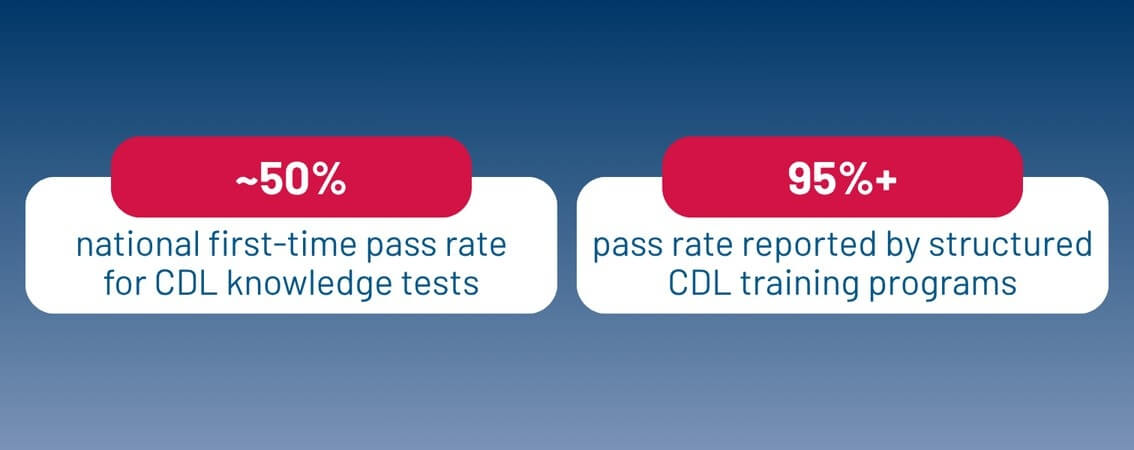 Source: Driving-Tests.org CDL program data. Individual school results may vary.
Key Takeaways
- Study your state's CDL manual — every test question comes directly from this book.
- Take practice tests daily for at least one week — they reveal weak spots and build test familiarity.
- Master the pre-trip inspection — it's one of the top failure points on the skills test.
- Memorize exact numbers — examiners expect precise answers on PSI, tread depths, and distances.
- Practice backing maneuvers more than anything else — it's the single most common failure point on the skills test.
- Enroll in a professional training program — some structured programs report pass rates of 95% or higher, compared to a national average of around 50%.
1. Study the CDL Manual Thoroughly
Your state's CDL manual is your primary resource. Every question on the knowledge test comes from this book. Download the California CDL handbook here.How to study it effectively
- Read it a minimum of three times — first for familiarity, then for retention.
- Focus only on sections that match your license class. Skip passenger and school bus chapters unless you need those endorsements.
- Mark key numbers and measurements as you go. Write summary notes in your own words.
- Use flashcards for specific numbers, measurements, and procedures.
- Start several weeks out. Daily study beats cramming every time.
2. Take CDL Practice Tests Regularly
Practice tests show you exactly where you stand before test day. Plan to take them daily for at least one week leading up to your exam.Where to find free practice tests
- Driving-Tests.org — general knowledge, air brakes, HazMat, school bus, and pre-trip. Includes manual-based explanations.
- CristCDL.com — free since 1999, no sign-up, unlimited attempts. Questions pulled directly from each state's DMV manual.
3. Enroll in a Professional CDL Training Program
Self-study works for some people, but structured programs offer something books can't: time behind the wheel in a real truck with an experienced instructor. National first-time pass rates for CDL knowledge tests hover around 50%, according to data from Driving-Tests.org. Some structured training programs report pass rates of 95% or higher for candidates who complete their programs. These programs combine classroom instruction with actual behind-the-wheel practice, which books alone can't provide.What to look for in a CDL school
- FMCSA approval — confirms the school meets federal safety and training standards. Verify this before enrolling.
- Student-to-instructor ratio — programs with 3:1 ratios give you more one-on-one time. Larger classes mean less individual attention.
- Job placement assistance — schools with carrier connections can move you from training to a paying job faster.
- Cost and financing — programs typically run $3,000 to $10,000. Company-sponsored options can drop this to as little as $155 in exchange for a driving commitment. Many schools offer scholarships and military benefits.
4. Master the Pre-Trip Inspection
The pre-trip inspection is one of the most common failure points on the CDL skills test. You must name each part, point to it, and explain what problems you're looking for. Vague language and missed components result in automatic failure.The 7-Point Inspection System
- Engine compartment: fluid levels, belts, hoses
- In-vehicle checks: gauges, brakes, emergency equipment
- Front of vehicle: lights, leaks, steering components
- Sides of vehicle: mirrors, fuel tanks, battery
- Rear of vehicle: lights and reflectors
- Coupling devices (combination vehicles): fifth wheel, air lines
- Trailer: damage, proper equipment
Common mistakes that cause failures
- Using vague or informal language instead of exact manual terminology
- Skipping the air brake test — this is an automatic failure
- Failing to state the exact tread depth: 4/32" for steer tires
- Rushing through or losing your order mid-inspection
5. Memorize Critical Numbers and Measurements
When examiners ask about air brake pressures, tire tread depths, or following distances, they expect exact answers. "Around" and "approximately" are not acceptable responses during testing.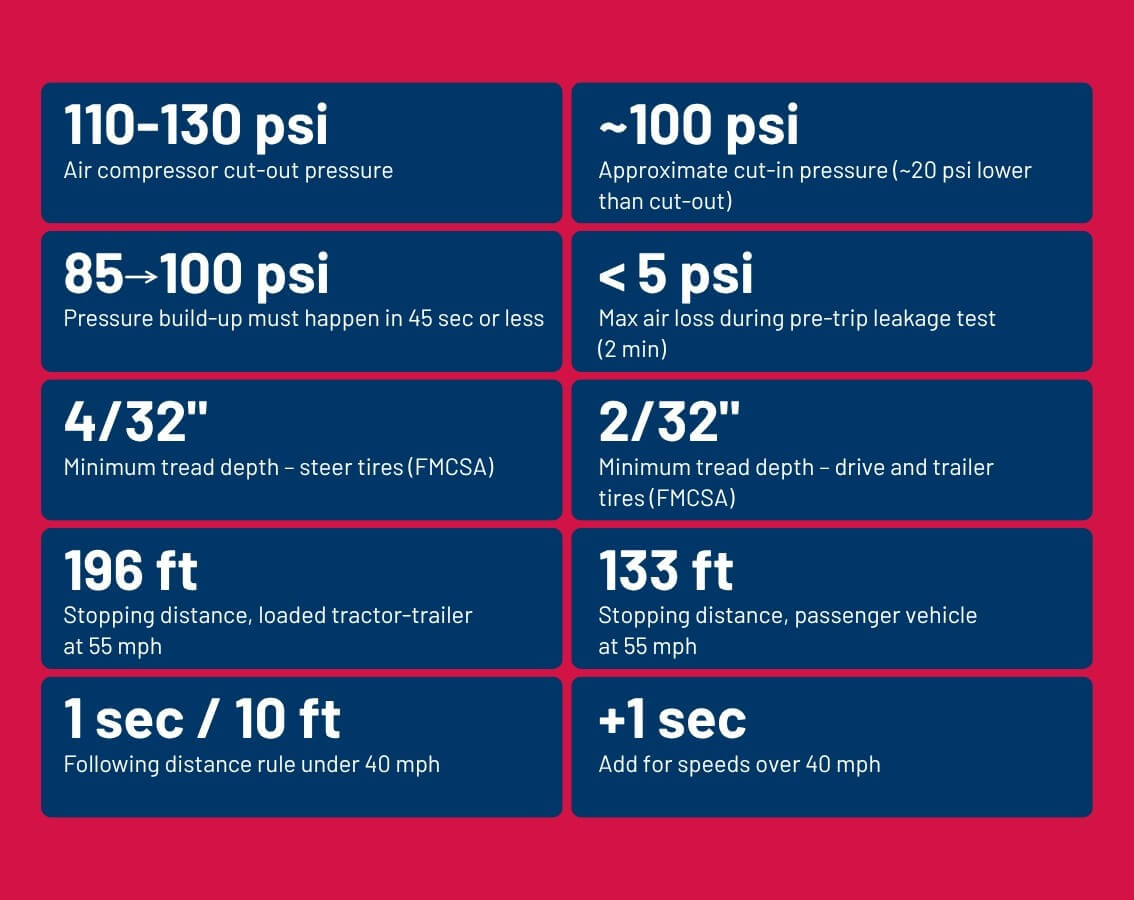 Sources: FMCSA regulations; state CDL manuals. Air brake pressure ranges may vary slightly by vehicle manufacturer.
6. Practice Backing Maneuvers Extensively
Backing maneuvers are the single most common failure point on the CDL skills test. The Basic Control Skills Test now includes 4 exercises in tighter spaces. Examiners choose from six possible maneuvers.The 6 possible backing exercises
- Straight-line backing — reverse between cone rows without hitting boundaries
- Offset backing — back left or right into a space beside your starting position
- Parallel parking (driver side) — standard parallel into a marked space
- Parallel parking (conventional) — right-side approach
- Alley docking — rear bumper must land within 3 feet of the end of the space
- Reverse offset backing — combines parallel and offset moves; rear bumper must land inside a 3-foot box
Scoring rules to know before you start
- Crossing a boundary line: 2 points
- Extra pull-up: 1 point
- Automatic failure: 13 points total
- Free moves: 1 pull-up + 1 look (straight-line); 2 of each (offset)
7. Understand Air Brake Systems Inside Out
The air brakes endorsement requires both theory and hands-on inspection knowledge. This is the single hardest portion of the CDL exam — 80% of first-time applicants fail it.Key components and what they do
- Air compressor — pressurizes air and sends it to storage tanks; runs continuously with the engine
- Governor — controls when the compressor pumps; cuts in around 100 psi, cuts out between 110-130 psi
- Air storage tanks — hold enough reserve for 10-12 full brake applications if the compressor fails
- Brake chambers — convert compressed air into mechanical force that stops the truck
- Slack adjuster — connects the pushrod to the S-cam, which forces brake shoes against the drum
- Spring brakes — emergency system; engage automatically if air pressure drops too low
Air brake inspection steps (in order)
- Turn the key on, then fan the service brake below 90 psi
- Start the engine and wait for the governor to cut out between 120-140 psi
- Press both truck and trailer air valves
- Run leakage test: hold service brake for 60 seconds and check for pressure drop
8. Get Plenty of Behind-the-Wheel Practice
Book knowledge prepares you for the written exam. Seat time builds the skills to pass the skills test. Most training programs structure it this way:Typical training progression
Week 2 — Straight-line backing, basic shifting, pre-trip practice Week 3 — Offset backing, alley docking, turning techniques Week 4 — Road driving on city streets, highways, and varying traffic conditions After every session: write down what went well and what gave you trouble. Use those notes to guide your next study period.9. Learn From Experienced Instructors
Federal rules require CDL instructors to hold a valid CDL and at least two years of commercial driving experience. Their hands-on background gives you access to practical knowledge that textbooks don't cover.Questions to ask before you enroll
- Have they driven long-haul routes in difficult conditions?
- Have they handled brake failures, blown tires, or emergency situations?
- Do they adjust their teaching based on how individual students learn?
10. Create a Structured Study Schedule
You must hold your Commercial Learner's Permit for at least 14 days before taking the CDL skills test. Use every one of those days with a plan.
Study in 45-minute sessions with short breaks in between. Silence your phone. Set a specific goal for each session — a number of pages, or one complete inspection section.Days 1-3 General knowledge and pre-trip inspection basics Days 4-6 Air brakes: components, pressure numbers, and inspection steps Days 7-9 Combination vehicles: coupling, uncoupling, and combination rules Days 10-12 Full practice tests — use scores to target weak areas Days 13-14 Light review only. Do not cram the night before. 11. Stay Calm and Manage Test Day Anxiety
Nerves are normal. The candidates who perform best on test day treat it like another training session rather than a high-pressure performance.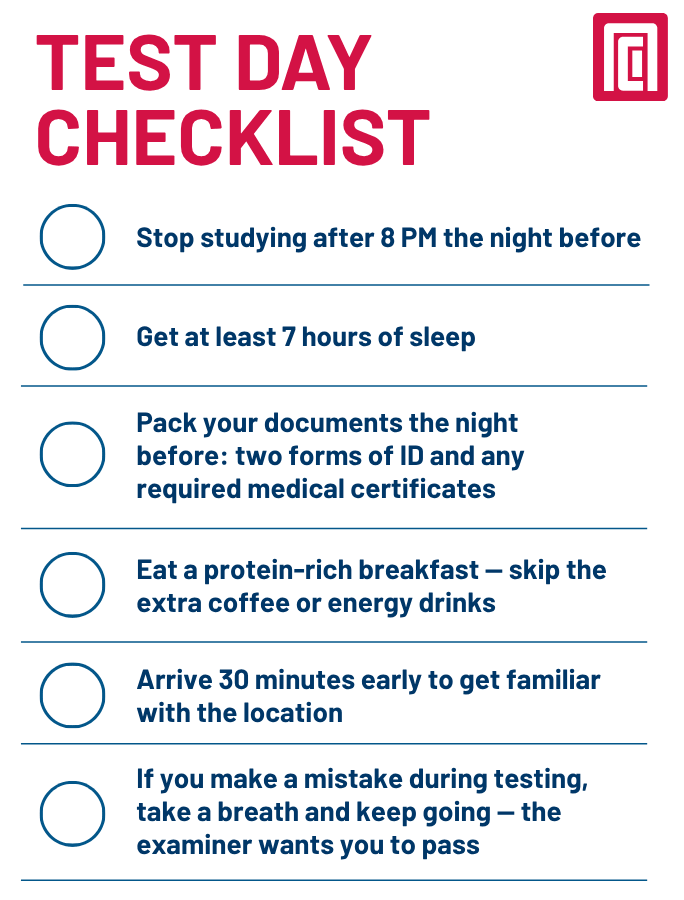
12. Know Why People Fail — and Avoid the Same Mistakes
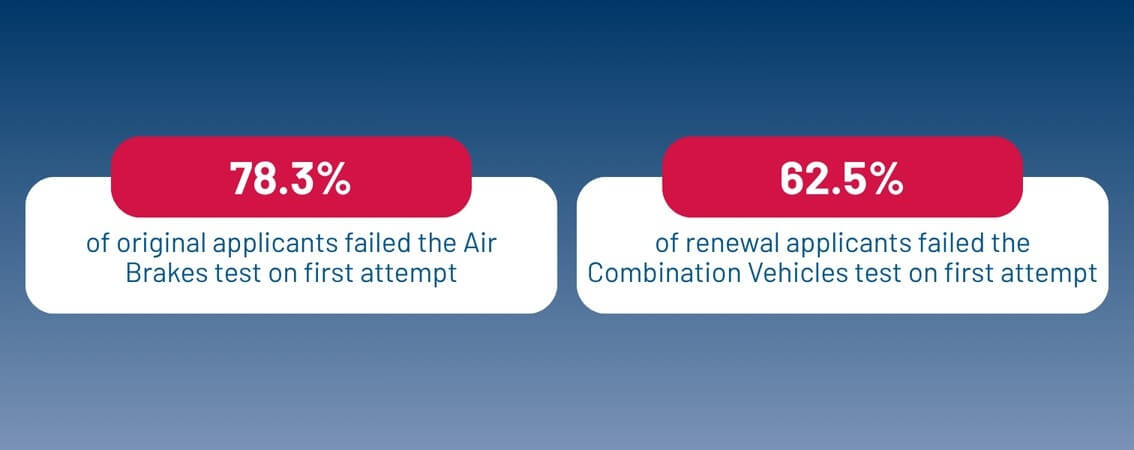 Source: California DMV, Statewide Evaluation of CDL Written Knowledge Tests (Research Report RSS-08-225, 2008). California-specific data; results may vary by state.
Understanding where candidates typically fail gives you a clear roadmap for where to focus your preparation. The two hardest written tests — Air Brakes and Combination Vehicles — have documented failure rates that underscore how much focused study they require.
Source: California DMV, Statewide Evaluation of CDL Written Knowledge Tests (Research Report RSS-08-225, 2008). California-specific data; results may vary by state.
Understanding where candidates typically fail gives you a clear roadmap for where to focus your preparation. The two hardest written tests — Air Brakes and Combination Vehicles — have documented failure rates that underscore how much focused study they require.
Written test failures
- Skipping the manual and relying on common sense — the exam covers technical specifics that require actual study
- Rushing through questions and making careless errors
- Second-guessing correct answers
- Using only practice tests without reading the manual — this leaves gaps that show up on test day
Skills test failures
- Turning too fast, causing the trailer to drift into other lanes
- Oversteering during straight-line backing or not catching trailer drift early
- Underestimating stopping distances and braking too late
- Safety violations — running red lights, failing to signal, or any accident during testing — result in automatic disqualification
Conclusion
Passing your CDL test on the first try comes down to preparation and consistency. Study your state's manual thoroughly, take practice tests daily, and enroll in a professional training program if you can. Focus extra attention on pre-trip inspections, backing maneuvers, and air brake systems — these are where most candidates fall short. Memorize the critical numbers, get real seat time behind the wheel, and build a structured study plan during your 14-day CLP waiting period. With the right preparation, first-time success is within reach.FAQs
How long should I study before taking my CDL test?
Start studying several weeks before your scheduled exam, with at least 45 minutes of focused study each day. Consistent daily sessions beat cramming and lead to better retention on test day.What is the minimum tire tread depth for CDL vehicles?
Steer tires require a minimum of 4/32 inch tread depth in every major groove; drive and trailer tires require 2/32 inch minimum.What are the most common reasons people fail the CDL skills test?
Backing maneuvers, particularly alley docking, are the top failure point. Other common failures include turning too fast, delayed braking, and incomplete or vague pre-trip inspections.What should I do on test day to perform my best?
Get at least 7 hours of sleep, eat a protein-rich breakfast, and arrive 30 minutes early. If you make a mistake during testing, take a breath, trust your training, and keep going. -

Show Your Appreciation For Our Road Heroes!
For many, the holiday season drums up memories of large food spreads, festive decorations adorning businesses and homes alike, and unwrapping gifts of all sizes. But have you ever stopped to think about how those items arrived in your hands just in time for your special celebration? Professional truck drivers play a large part in that process. They transport goods from turkeys to holiday trees and everything in between. These men and women sacrifice spending this special time with their loved ones to ensure our gatherings go off without a hitch. Now more than ever, it's important to show them how thankful we are for their service. Keep reading to see different ways you can thank a professional driver during this time of giving!Thank A Driver with a Home Cooked Meal
Drivers have limited home-cooked meal options while on the road, meaning they often eat typical truck stop snacks or fast-food items. To show appreciation for the hard work they are providing this season, you can opt to share your own turkey spread! Alternatively, there are many organizations, such as Meals for 18 Wheels, where you can volunteer to deliver ready-made meals to drivers. Whichever you choose may seem like a small sentiment, but truck drivers will for sure be very grateful!Show Thanks by Picking Up the Check
If your celebrations happen at a restaurant or diner, check if any drivers are also enjoying a meal. If so, you can offer to cover their bill. You could even invite them to join in your festivities, as many of them are away from their own celebrations and traditions. Truck drivers can provide great company and interesting conversations, as they encounter something new every day that they're driving across the country. And to think, all of that could begin with a small kind gesture of gratitude!Spread Holiday Cheer with Thank-You Themed Goody Bags
A great way to get the whole family involved is to set up a goody bag creation station to pass out to drivers you encounter throughout the season. The bags can be filled with travel-size essential items, grab-and-go snacks, or holiday-themed décor they can use to spruce up their trucks. You might also want to include a themed greeting card that everyone can sign. The best part – these items can be purchased at your local dollar store! Once all the bags are filled, make sure to keep them somewhere that can be easily accessed to hand out, such as your car. This inexpensive gift idea can have the biggest impact on a driver’s day!Post on Social Media Using the #ThankATrucker Hashtag
Social media has become a very popular way for drivers to keep in touch with their family and friends. This gives you the perfect opportunity to show your thankfulness to drivers, and best of all – it's free to do! Before you post, make sure to include the hashtag #ThankATrucker so your message can reach even more drivers than you thought possible! You can also repost messages from others who are using the hashtag to spread their positive sentiments. Lastly, you can ask your friends or followers to also create a caption with the hashtag and help spread good messages to all drivers!Truck Drivers Thank Advanced Career Institute
While everyone is thanking our heroes of the road, truck drivers are also showing their gratitude to those who helped them get where they are today. Advanced Career Institute has received many heartfelt messages of thanks and appreciation from our graduates who underwent our CDL training program and have gone on to create successful and lucrative driving careers with our trucking partners. Many graduates share their stories with us online, but some make sure to stop by their campus in person. Drivers also make sure to stop by our Job Placement program offices to pass along their gratitude to those who helped get the ball rolling toward their new careers.Let ACI help you begin your new driving career! Fill out the form on this page or give us a call at 866-218-7968 to get your spot reserved in our next class!
-

Learn the dangers of underinflated tires and how to avoid them
A recent study by Continental Tires revealed that 34% of fleet drivers regularly ride on underinflated tires. Continental’s survey pointed to a lack of driver knowledge about the risks of driving on underinflated tires and a lack of education on how to monitor and maintain tires as a culprit of this. This is epitomized by the survey’s other finding that only 50% of fleet drivers know the optimal inflation level for their tires. In an attempt to combat this problem, here are some of the risks associated with driving on underinflated tires and some measures that truck drivers can take to ensure this does not happen.Risks of driving on underinflated tires
Reduced Traction and Poorer Steering -Underinflated tires will not grip the road as well as tires that are fully inflated. This means that vehicles can be more challenging to steer, particularly in wet conditions or driving on imperfect road surfaces. This presents a real danger to road users. According to the National Transportation Safety Board, there are around 33,000 accidents each year due to tire-related issues. Underinflated tires are one of the most commonly cited issues of this kind. Increased Chance of Tire Blowout- When a tire is underinflated, pressure from the road transfers from the supple tread of the tire to the more brittle tire sidewall. As the tire’s sidewall is not designed to take such pressure, this can lead to tire blowouts. A sudden blowout on a highway can be very dangerous. Blowouts are estimated to cause 2,000 accidents each year in the US. Furthermore, blowouts can also lead to long periods of driver downtime and mess up schedules. Poorer Fuel Economy - Low tire pressure increases the amount of friction there is between the tire and the road. This means that it takes more fuel to move a vehicle at the same speed than when tires are properly inflated. Although this may not affect a driver too much, improving fuel economy is one of the biggest priorities of fleet managers and operators. This is because fuel consumption typically takes up 60% of a fleet’s total operating costs.How can Truck Drivers Ensure their Tires are Always Fully Inflated?
Knowing your tire inflation specifications - Given that 50% of truck drivers do not know the pressure that their tires should be inflated at, just knowing this basic information will help you be more responsible about your tires than most of your colleagues. You can find out your truck’s optimal tire pressure by looking at the vehicle’s driver manual. Generally recommended tire pressure is between 35-40 PSI, but this can vary from truck to truck. Measure your Tire Pressure at Least Once a Month - Since some air will always be leaking out of tires, it’s essential to check your tire pressure at least once every four weeks. You can measure tire pressure with a tire pressure gauge. This tool costs less than $15 and is small enough to be kept in your truck’s glove compartment. As the heat caused by driving (particularly highway driving) causes tire pressure to increase, you should always measure your tire pressure when your tires are “cold.” A “cold” tire has not been driven on for at least 2 hours. Although most trucks will be fitted with a tire pressure monitoring system, this will only alert you when a tire has deflated below 25% of its optimal pressure. This is far beyond the point where steering and fuel economy are affected, so it’s well worth regularly measuring tire pressure manually.Keep an Eye out for Outerwear on your Tires
If you drive underinflated tires for an extended time, the outer edges of your tire will wear faster than the middle of the tread. This is because more pressure is exerted on the outside of tires when underinflated. Remember, is why underinflation can lead to blowouts. We can often feel outerwear if we run our hand over the tread of our tires. You should be able to notice the tactile sensation of tire treads being shallower on the outside of the tread than in the middle. If this is the case, then it’s worth measuring your tire pressure to see if tires are underinflated, as well as being more diligent with keeping your tires inflated in the future. - Written by Mike Skoropad -
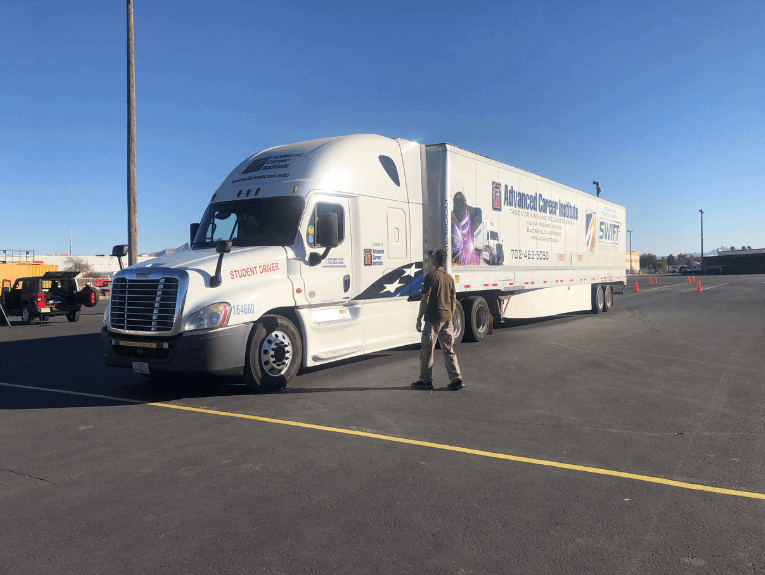
Our New Nevada Campus for Professional Truck Driver Training
Advanced Career Institute is excited to open a CDL Training facility in Las Vegas, Nevada. We saw an opportunity to help train the next generation of professional truck drivers and we could not be happier to expand our training locations. Our Las Vegas campus is located at 4020 E Lone Mountain Rd Suite 100 North Las Vegas, NV 89081. Our staff is ready and excited to work with our students!Las Vegas CDL Training Facility
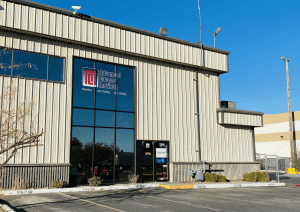 Our new campus is designed to give our students the best facility to practice their skills and start their careers in the trucking industry. Students will begin their CDL training by expanding their knowledge about the trucking industry, equipment, and regulations in our newly updated classrooms. Students will then get the chance to practice their driving skills and backing maneuvers on our four-acre paved training yard. For anyone looking to obtain their Class A CDL in Nevada, look no further. ACI's admissions and training staff is ready to help new students get signed up and started on their journey to a great trucking career.
What To Expect During Truck Driver Training
We have new classes starting every couple of weeks! Students will be able to have a CDL license and a new career in their hands a just a couple of weeks. Our 4-week program is 160 clock hours of training. Our trainers will first prepare students to take their written CDL permit exam. The remaining in-classroom training will be used to learn rules and regulations and the ins and outs of your vehicle. Students will then move onto yard training where they will get behind the wheel of one of our beautiful trucks.How to Get Your Class A CDL in Nevada
- Make sure you meet all of the requirements necessary to get your Commercial Driver's License.
- Contact Advanced Career Institute's Las Vegas Campus to sign up for training.
- Next, obtain your CDL permit. As previously mentioned, when training with ACI, we will help prepare you to take your CDL permit exam during your first two weeks of classroom training.
- You will need to submit a driving record check. Our admissions staff will help you with this step.
- Complete your 160 hours of training with ACI and schedule your CDL exam.
If you are ready to start training for your Commercial Driver's License in Las Vegas, Nevada, we are ready for you! Give us a call today! 702-463-5050
-

What's Next for the Trucking Industry?
Its no question that COVID has had an impact not only on the trucking industry but every industry in America. From small businesses to corporations, everyone has had to adapt and find a new normal. The trucking industry adapted and became a key piece that held our economy together during the months of quarantine. Going into the new year, it was clear that 2021 was going to be a rebound year for freight and the trucking industry according to FTR Transportation Intelligence. With this in mind, let’s look at some reasons the trucking industry can be thankful post-COVID.The Rise of E-Commerce
E-commerce has rapidly grown since it first began, but especially since March of 2020 when COVID impacted in-person shopping habits. Overall, online shopping grew 44% during 2020 in comparison to 2019. This resulted in a significant increase in products that needed to be shipped and delivered via trucks. E-commerce and online sales are expected to stay high this year. They may drop slightly compared to 2020 due to fewer COVID restrictions, but the current volume of online shopping has become the new normal. In 2021, truckers can expect to continue to have plenty of loads to haul due to this rise in e-commerce. Traditional brick and mortar stores are also beginning to fully open back up, meaning truckers will have deliveries to stores added back to their routes as well.Remote Work is Here to Stay
Working remotely was a huge adjustment many companies had to make in 2020. This actually greatly benefitted truck drivers because there was less traffic on roads and deliveries were made easier. Some companies even reported deliveries were made 3x quicker by truckers during this time. With how successful remote work proved to be, many companies are now allowing workers to stay and work from home in the future. This will continue to help make travel safer for truckers even after COVID because working from home has now become the new normal.Contactless Technology
One of the more efficient upgrades we saw during the pandemic was the number of companies that added a contactless or paperless approach to their business models. New technologies were implemented due to the highly contagious nature of the virus. Electronic contracts and bills are quicker and more efficient than traditional paper. Contactless pick-up and delivery services now give truckers more options when they are on the road. Drivers no longer have to walk from their trucks to security stations or warehouses and now have the ability to do almost everything online.The 2021 Year
Areas that are likely to continue to see strongholds and growth are grocery stores and retail carriers. The demand is still high for both industries and will be for the foreseeable future. Another industry that is going to continue to grow is final-mile delivery and medical carriers. With the continued rollout of the vaccine and medical supplies, in addition to the rise of e-commerce mentioned earlier, both should have a strong presence in 2021. If you are a new truck driver looking to get started in the industry, it would be a good idea to talk with your potential employers about the industries they are working within.A Changing Industry
The trucking industry post-COVID will be different than it was before. Luckily many differences seem to be for the better. The trucking industry has shown it has the ability to adapt to the changing needs of its communities and continue to succeed no matter what obstacles are thrown it's way. If you have chosen a career in the trucking industry, chances are that no matter what happens to the economy, truck drivers have to continue trucking. One thing that won't change in the industry is the need for professional drivers. The shortage of truck drivers continues to grow, and carriers will always need new drivers. Advanced Career Institute is proud to help train the next generation of professional truck drivers through our CDL training programs. If you would like to join an essential and growing industry, contact us today by filling out the form or calling 877-649-9614! -

The eyes and ears of our nation’s highways
(Updated June 24, 2024) Human trafficking has been a hot topic in the news lately, but it’s been a persistent issue for centuries. Even with an unsettling 28 million victims of human trafficking, countless individuals are still blinded to the matter. Unfortunately, truck drivers see it occurring in plain sight. In hopes to build awareness of the ongoing problem with human trafficking, January was named National Human Trafficking Awareness Month. We encourage you to take a look at how you can participate this month.What is Human Trafficking?
Human trafficking is the exploitation of human beings through force, fraud or coercion for the purpose of commercial sex or forced labor. The following information is from Women On Guard, dosomething.org and Truckers Against Trafficking.- Globally, human trafficking brings in $150 billion a year for traffickers.
- The National Human Trafficking Hotline received more calls from California than any other state followed by Texas and Florida.
- 2,692 of those calls made to NHTH were by truck drivers.
- About 50,000 people are trafficked into the US each year, most often from Mexico and the Philippines.
- 1,296 human trafficking victims have been identified by the transportation industry.
Truckers Against Trafficking
Truck drivers have shown they are in business to save lives. Truckers Against Trafficking was established in 2009 to empower the trucking, bus and energy industries to take a public stand against human trafficking. Currently, 1,014,367 truck drivers have completed their Certified Trucker Against Trafficking program. Over the years, TAT has received recognition from the U.S. Congress and the United Nation’s 100 Best Practices list for their dedicated success. Plus, they have partnered with numerous motor carriers, trucking industry associations, government transportation agencies, truck stops, travel plazas and law enforcement.Hero of the Highway
Millions of truck drivers have become the eyes and ears of our nation’s highways, like Kevin Kimmel. In 2015, Kimmel saved a woman from modern-day slavery. At the time, he was pulling into a truck stop to sleep, and saw a distraught young woman through the darkened window of an RV. He decided things didn’t look right and called local law enforcement. When the police arrived, they found the 20-year-old woman malnourished and frightened. The woman had been kidnapped two weeks prior, and because of Kimmel, she is free.Drivers Encouraged to Participate in #WearBlueDay
National Human Trafficking Awareness Day is recognized on January 11. The Blue Campaign, a public awareness campaign created by the U.S. Department of Homeland Security, hosts several events and educational activities. One of their largest initiatives is #WearBlueDay. To participate, take a photo of yourself dressed in blue and share your photo on social media with the hashtag #WearBlueDay. Check out some creative ways to raise awareness or take a look at how other truck drivers have helped combat human trafficking.3 Ways Truck Drivers Can Make a Difference
- Get Certified. If you’ve received your CDL training, join Truckers Against Trafficking’s army of transportation professionals working to disrupt human trafficking. The Truckers Against Trafficking test is free for all truck drivers. You can get certified online or see if your organization offers training.
- Follow your instincts. Call or text the National Human Trafficking Hotline to report a tip if you ever believe you may have information about a trafficking situation.
- Don’t turn a blind eye. If you witness any suspicious activity notify the truck stop employee or call local law enforcement.
If you are interested in becoming a hero of the highway, learn more about how to become a licensed CDL Truck Driver. America is depending on you!