
The trucking industry faces a shortage of about 80,000 drivers, according to the American Trucking Associations. Demand for qualified CDL holders is high, and the right preparation makes a measurable difference in whether candidates pass on the first attempt. This guide covers the 12 strategies that matter most.
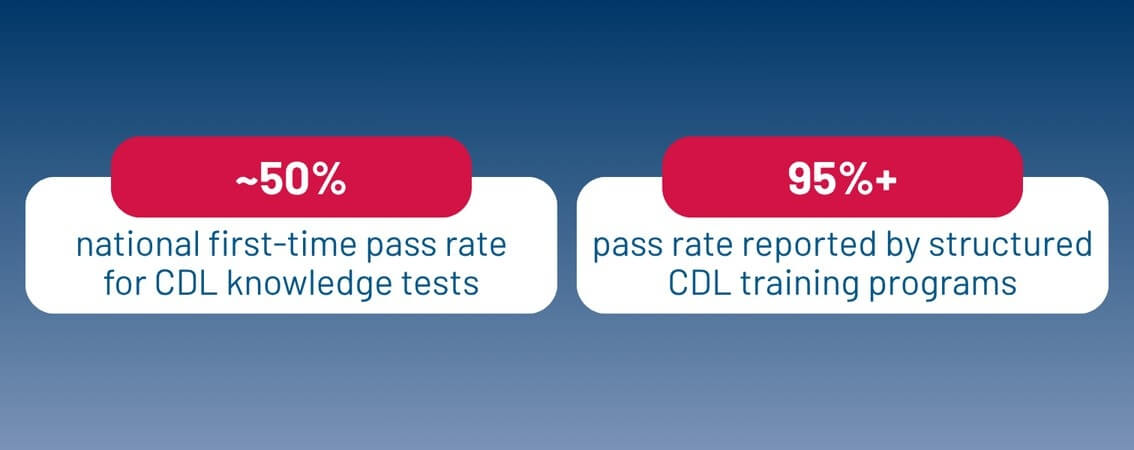
Source: Driving-Tests.org CDL program data. Individual school results may vary.
Key Takeaways
- Study your state’s CDL manual — every test question comes directly from this book.
- Take practice tests daily for at least one week — they reveal weak spots and build test familiarity.
- Master the pre-trip inspection — it’s one of the top failure points on the skills test.
- Memorize exact numbers — examiners expect precise answers on PSI, tread depths, and distances.
- Practice backing maneuvers more than anything else — it’s the single most common failure point on the skills test.
- Enroll in a professional training program — some structured programs report pass rates of 95% or higher, compared to a national average of around 50%.
1. Study the CDL Manual Thoroughly
Your state’s CDL manual is your primary resource. Every question on the knowledge test comes from this book. Download the California CDL handbook here.
How to study it effectively
- Read it a minimum of three times — first for familiarity, then for retention.
- Focus only on sections that match your license class. Skip passenger and school bus chapters unless you need those endorsements.
- Mark key numbers and measurements as you go. Write summary notes in your own words.
- Use flashcards for specific numbers, measurements, and procedures.
- Start several weeks out. Daily study beats cramming every time.
2. Take CDL Practice Tests Regularly
Practice tests show you exactly where you stand before test day. Plan to take them daily for at least one week leading up to your exam.
Where to find free practice tests
- Driving-Tests.org — general knowledge, air brakes, HazMat, school bus, and pre-trip. Includes manual-based explanations.
- CristCDL.com — free since 1999, no sign-up, unlimited attempts. Questions pulled directly from each state’s DMV manual.
Start in study guide mode to learn the material, then switch to timed mode to simulate real test pressure. Retake as many times as needed.
3. Enroll in a Professional CDL Training Program
Self-study works for some people, but structured programs offer something books can’t: time behind the wheel in a real truck with an experienced instructor.
National first-time pass rates for CDL knowledge tests hover around 50%, according to data from Driving-Tests.org. Some structured training programs report pass rates of 95% or higher for candidates who complete their programs. These programs combine classroom instruction with actual behind-the-wheel practice, which books alone can’t provide.
What to look for in a CDL school
- FMCSA approval — confirms the school meets federal safety and training standards. Verify this before enrolling.
- Student-to-instructor ratio — programs with 3:1 ratios give you more one-on-one time. Larger classes mean less individual attention.
- Job placement assistance — schools with carrier connections can move you from training to a paying job faster.
- Cost and financing — programs typically run $3,000 to $10,000. Company-sponsored options can drop this to as little as $155 in exchange for a driving commitment. Many schools offer scholarships and military benefits.
Most full-time programs run 3 to 6 weeks. Part-time options stretch to 3 months
4. Master the Pre-Trip Inspection
The pre-trip inspection is one of the most common failure points on the CDL skills test. You must name each part, point to it, and explain what problems you’re looking for. Vague language and missed components result in automatic failure.
The 7-Point Inspection System
- Engine compartment: fluid levels, belts, hoses
- In-vehicle checks: gauges, brakes, emergency equipment
- Front of vehicle: lights, leaks, steering components
- Sides of vehicle: mirrors, fuel tanks, battery
- Rear of vehicle: lights and reflectors
- Coupling devices (combination vehicles): fifth wheel, air lines
- Trailer: damage, proper equipment
Common mistakes that cause failures
- Using vague or informal language instead of exact manual terminology
- Skipping the air brake test — this is an automatic failure
- Failing to state the exact tread depth: 4/32″ for steer tires
- Rushing through or losing your order mid-inspection
5. Memorize Critical Numbers and Measurements
When examiners ask about air brake pressures, tire tread depths, or following distances, they expect exact answers. “Around” and “approximately” are not acceptable responses during testing.
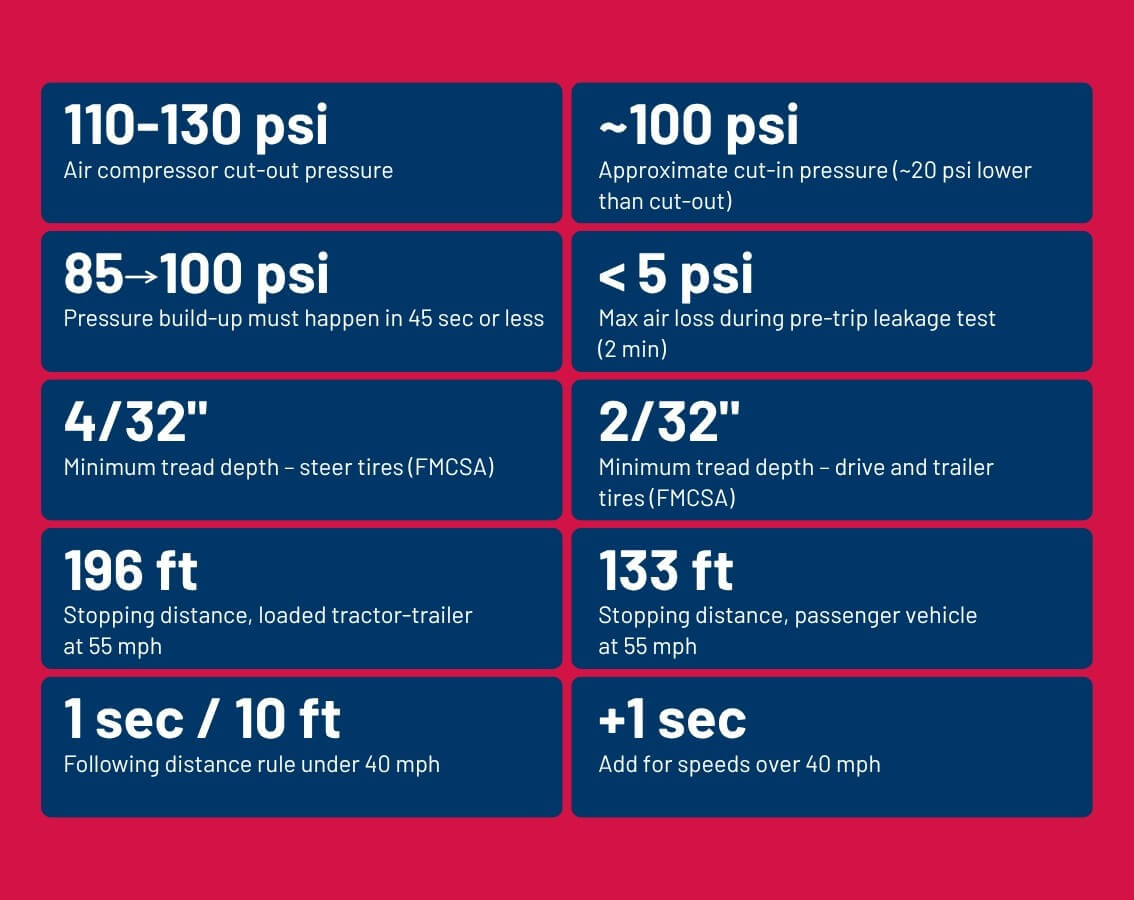
Sources: FMCSA regulations; state CDL manuals. Air brake pressure ranges may vary slightly by vehicle manufacturer.
6. Practice Backing Maneuvers Extensively
Backing maneuvers are the single most common failure point on the CDL skills test. The Basic Control Skills Test now includes 4 exercises in tighter spaces. Examiners choose from six possible maneuvers.
The 6 possible backing exercises
- Straight-line backing — reverse between cone rows without hitting boundaries
- Offset backing — back left or right into a space beside your starting position
- Parallel parking (driver side) — standard parallel into a marked space
- Parallel parking (conventional) — right-side approach
- Alley docking — rear bumper must land within 3 feet of the end of the space
- Reverse offset backing — combines parallel and offset moves; rear bumper must land inside a 3-foot box
Scoring rules to know before you start
- Crossing a boundary line: 2 points
- Extra pull-up: 1 point
- Automatic failure: 13 points total
- Free moves: 1 pull-up + 1 look (straight-line); 2 of each (offset)
Key technique: steering is reversed when backing. Turn the wheel opposite to the direction you want the trailer to go. Use idle speed and small corrections — large wheel movements push you off course.
7. Understand Air Brake Systems Inside Out
The air brakes endorsement requires both theory and hands-on inspection knowledge. This is the single hardest portion of the CDL exam — 80% of first-time applicants fail it.
Key components and what they do
- Air compressor — pressurizes air and sends it to storage tanks; runs continuously with the engine
- Governor — controls when the compressor pumps; cuts in around 100 psi, cuts out between 110-130 psi
- Air storage tanks — hold enough reserve for 10-12 full brake applications if the compressor fails
- Brake chambers — convert compressed air into mechanical force that stops the truck
- Slack adjuster — connects the pushrod to the S-cam, which forces brake shoes against the drum
- Spring brakes — emergency system; engage automatically if air pressure drops too low
Air brake inspection steps (in order)
- Turn the key on, then fan the service brake below 90 psi
- Start the engine and wait for the governor to cut out between 120-140 psi
- Press both truck and trailer air valves
- Run leakage test: hold service brake for 60 seconds and check for pressure drop
8. Get Plenty of Behind-the-Wheel Practice
Book knowledge prepares you for the written exam. Seat time builds the skills to pass the skills test. Most training programs structure it this way:
Typical training progression
Week 2 — Straight-line backing, basic shifting, pre-trip practice
Week 3 — Offset backing, alley docking, turning techniques
Week 4 — Road driving on city streets, highways, and varying traffic conditions
After every session: write down what went well and what gave you trouble. Use those notes to guide your next study period.
9. Learn From Experienced Instructors
Federal rules require CDL instructors to hold a valid CDL and at least two years of commercial driving experience. Their hands-on background gives you access to practical knowledge that textbooks don’t cover.
Questions to ask before you enroll
- Have they driven long-haul routes in difficult conditions?
- Have they handled brake failures, blown tires, or emergency situations?
- Do they adjust their teaching based on how individual students learn?
Strong instructors will give you extra time on weak areas — parallel parking, pre-trip inspection, backing — without rushing through the material to stay on schedule.
10. Create a Structured Study Schedule
You must hold your Commercial Learner’s Permit for at least 14 days before taking the CDL skills test. Use every one of those days with a plan.
| Days 1-3 | General knowledge and pre-trip inspection basics |
| Days 4-6 | Air brakes: components, pressure numbers, and inspection steps |
| Days 7-9 | Combination vehicles: coupling, uncoupling, and combination rules |
| Days 10-12 | Full practice tests — use scores to target weak areas |
| Days 13-14 | Light review only. Do not cram the night before. |
Study in 45-minute sessions with short breaks in between. Silence your phone. Set a specific goal for each session — a number of pages, or one complete inspection section.
11. Stay Calm and Manage Test Day Anxiety
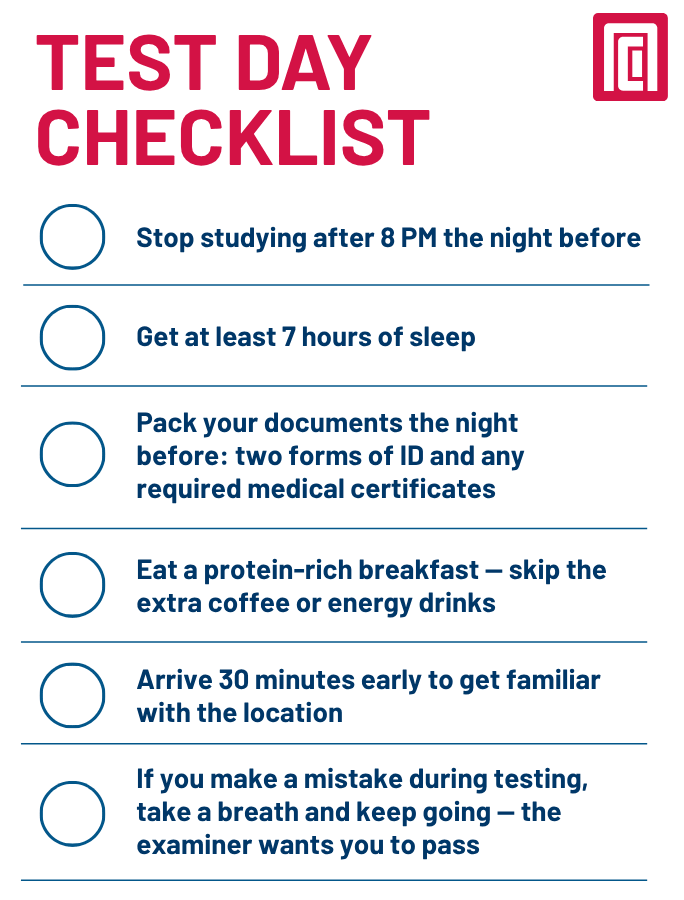
Nerves are normal. The candidates who perform best on test day treat it like another training session rather than a high-pressure performance.
12. Know Why People Fail — and Avoid the Same Mistakes
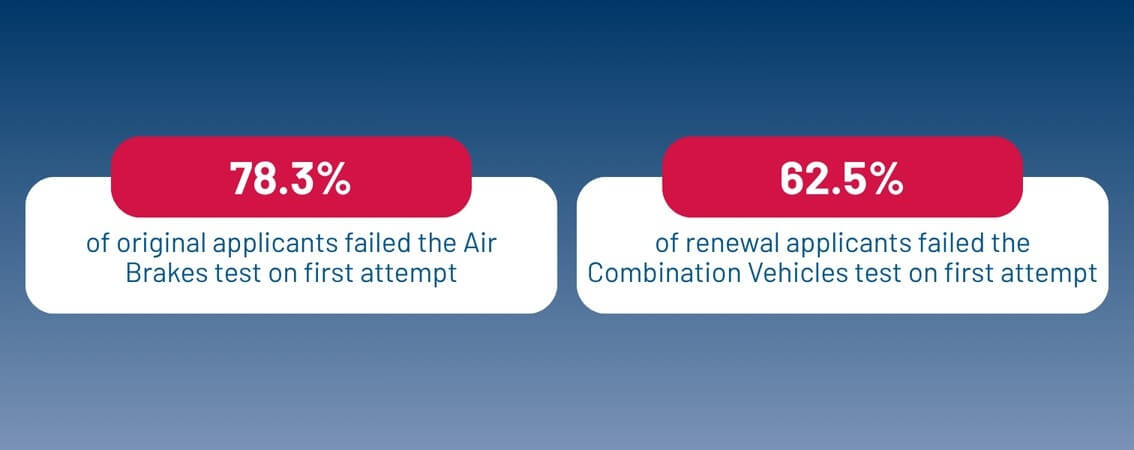
Source: California DMV, Statewide Evaluation of CDL Written Knowledge Tests (Research Report RSS-08-225, 2008). California-specific data; results may vary by state.
Understanding where candidates typically fail gives you a clear roadmap for where to focus your preparation. The two hardest written tests — Air Brakes and Combination Vehicles — have documented failure rates that underscore how much focused study they require.
Written test failures
- Skipping the manual and relying on common sense — the exam covers technical specifics that require actual study
- Rushing through questions and making careless errors
- Second-guessing correct answers
- Using only practice tests without reading the manual — this leaves gaps that show up on test day
Skills test failures
- Turning too fast, causing the trailer to drift into other lanes
- Oversteering during straight-line backing or not catching trailer drift early
- Underestimating stopping distances and braking too late
- Safety violations — running red lights, failing to signal, or any accident during testing — result in automatic disqualification
Conclusion
Passing your CDL test on the first try comes down to preparation and consistency. Study your state’s manual thoroughly, take practice tests daily, and enroll in a professional training program if you can. Focus extra attention on pre-trip inspections, backing maneuvers, and air brake systems — these are where most candidates fall short. Memorize the critical numbers, get real seat time behind the wheel, and build a structured study plan during your 14-day CLP waiting period. With the right preparation, first-time success is within reach.
FAQs
How long should I study before taking my CDL test?
Start studying several weeks before your scheduled exam, with at least 45 minutes of focused study each day. Consistent daily sessions beat cramming and lead to better retention on test day.
What is the minimum tire tread depth for CDL vehicles?
Steer tires require a minimum of 4/32 inch tread depth in every major groove; drive and trailer tires require 2/32 inch minimum.
What are the most common reasons people fail the CDL skills test?
Backing maneuvers, particularly alley docking, are the top failure point. Other common failures include turning too fast, delayed braking, and incomplete or vague pre-trip inspections.
What should I do on test day to perform my best?
Get at least 7 hours of sleep, eat a protein-rich breakfast, and arrive 30 minutes early. If you make a mistake during testing, take a breath, trust your training, and keep going.