RESOURCES

Helpful Information About Potential Welding Careers & Trucking Jobs

Check out this selection of articles below to learn more about career choices and how to prepare for in-demand job opportunities.

  • image of a woman welding a fence at a construction site, wearing proper safety gear.

    4 Myths About the Welding Workplace

    Only about 5.8 percent of working welders are females, according to the American Welding Society. Companies are doing more outreach to women to help replace the welders who are approaching retirement. Welding is a career that can offer many benefits, but there are still a few misconceptions about women doing this type of work.

    Myth 1: Companies Don’t Want to Hire a Female Welder

    Metal fabricating companies are desperate to find good welders to replace the workforce that is rapidly retiring now. Both women and men are great candidates for these positions. Anyone can have a promising career in welding, as long as they get the proper training. Having additional skills, such as blueprint reading, will help you be a more valuable employee for prospective employers. Keep in mind that there may not always be welding jobs available in your area, and you may have to move to a more industrial city to find the job you want.

    Myth 2: Male Co-Workers Don’t Respect Female Workers

    Although male welders may have resented women coming into the field in the past, the younger generation is less apt to hold on to these gender differences in the workplace. They may have worked alongside women in the military or in other fields of work. They respect anyone who does good work and can work well as part of a team.

    Myth 3: Welding Work is Hard, Dirty and Dangerous

    Not all shop settings are alike. Some companies may not have state-of-the-art equipment or the safest environment. However, there are welding positions in forward-thinking companies with clean, climate-controlled environments and manageable materials. Female and male welders can benefit from staying fit in order to manipulate the heavy materials. They should also take safety classes to ensure that they can protect themselves and others in the work environment.

    Myth 4: There’s No Room For Professional Growth in Welding

    Many welders become supervisors or consultants. They work on projects that involve welding processes for construction or manufacturing of products. In addition, welding offers the opportunity of starting your own business, which can bring increased financial benefits. Women in welding is still a relatively new concept, but it is fast becoming the norm as more companies look for reliable people who can perform the highly technical work that welders do every day. Interested in joining the community of women welders? Learn more about our welder training program today!
  • image of truck stop restaurant and gas station sign

    The Daily Trucking Job Routine

    Updated July 2022 OTR truck drivers live on the corner of freedom and responsibility. They have the freedom to travel the highways and explore new locations on a near daily basis. They also must obey the rules of the road, listen to their dispatchers, and deliver their loads on time. There are more rules of the road for truckers than for drivers of non-commercial vehicles. These include log books, weight limits, and lane restrictions. While they have the most spectacular window views and are never confined to a stationary desk, that freedom is carefully recorded and monitored. After picking up a heavy load, truckers head off to the scales to make sure that their weight is within the correct limit and distributed properly. This is routine business. The same goes for carefully monitoring the hours you’ve spent driving and keeping your logbook up to date. These tedious chores ensure that you don’t end up sidelined when you slip through the chicken house and receive an unexpected inspection.

    Routine & Flexibility

    The average OTR truck driver will typically travel between 80,000 to 110,000 miles per year. They end up sitting behind the wheel for around 450 miles per day. Most company drivers have little control over where their next load will take them. They may rush to hit a tight deadline and then enjoy some downtime while waiting for their turn to unload. You could say they live on the corner of Hurry Up and Wait. It is critical, though, that drivers maintain the willingness to work hard and the flexibility to handle delays and unexpected circumstances. While trucking requires flexibility in scheduling, most drivers do establish routines that provide some sense of stability. For instance, they establish favorite truck stops in every region of the country. There’s nothing like a friendly face, warm cup of coffee, and a hot shower when you’ve been on the road eating from your personal stash of snacks or at fast-food restaurants for days. These routines often center around grooming, which is critical for an OTR truck driver. They don’t have direct access to showers but need to remain presentable when representing their company at delivery points. Identifying truck stops with clean showers, laundry facilities, television rooms, and other amenities is important.

    Modern Trucking

    Trucking life has changed considerably due to technological advancement. Drivers are no longer cut off from their loved ones or forced to talk via pay phone. They can now video chat with loved ones in their downtime. They can receive text messages, emails, and make phone calls from their trucks. This has created a more socially connected trucking world that is healthier for the OTR truck driver as well as those back home missing a truck driver. Connection and Solitude is just another corner on which many drivers now live. Interested in living the trucking lifestyle? Learn more about our Class A OTR truck driver training programs!
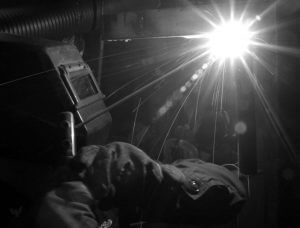
  • Image of welder with blue flame

    3 Things Welders Need to Know to Survive

    The commercial use of metals in the construction of equipment, buildings, ships and airplanes has created terrific employment opportunities. Welders can earn good salaries because of their skills. Although welders can earn a lot of money, the job can be hazardous due to high temperatures, materials and work environments. For those on an arc welding path, always put safety first. Here are some welding safety tips to keep in mind.

    Electricity

    Arc and other forms of welding use high voltage electrical equipment. The power can range from 20 to 100 volts. Death can result from exposure to less than 50 volts under certain conditions. It’s imperative that you understand and respect electricity. Never work in a wet or damp space. These include puddles, ground water or even where someone spills a coffee. Never handle electrified materials without safety gloves. If you are holding an electrified tool or material and touch another conductor, this can complete an electrical circuit right through your body.

    Fire

    The heat of a welding arc can hit 10,000 degrees. Be certain that you are not working near any combustible materials. Keep in mind that the arc itself does not have to touch other materials to start a fire. The sheer heat can start a blaze. Also, arc spatter is like shooting off a Roman candle. Work at least 35 feet away from flammable materials.

    Safety Equipment

    Always wear a complete outfit of safety equipment that includes rated clothing, gloves, face shield, safety glasses, and hearing protection. In commercial settings, you are not only protecting yourself from your own work, but also from those around you. Here are some of the common injuries caused by poor safety gear.
    • Eye protection: Arc rays can cause what welders call “arc flash” that damages your eyesight. It can occur from other welders working to your side or even behind you. Also, small metal shards can become embedded in your eyes.
    • Rated Clothing: High UV radiation produced by arc rays can cause intense skin burns. Welding spatter can burn through inadequate gear. Cover up.
    • Ear Plugs: The high decibels from welding and metal gauging can damage your hearing.
    • Helmets: Accidents such as falling materials can occur in industrial setting. Protect your head.
    Welders enjoy a tremendous trade that has an excellent future. Always place safety as your highest priority and arc on! Learn more about welding techniques and safety tips through our welder training program. Check out our calendar to see when the next welding class starts.
  • Image of a person in drivers seat of a truck

    The Benefits of Each Type of CDL License

    EDITORS NOTE: Class B CDL training is no longer offered at ACI. Check out all of our CDL training programs offered HERE. Looking for work in the white-collar world can be tough. You need top-notch education and training, which can be very expensive and time-consuming. Perhaps you’ve thought of making a major career change. Finding a new profession can be much easier in the blue-collar world. Professions in the blue-collar world that are always in need are those requiring people with CDL licenses. People with CDL licenses drive semis, school buses, and other labor-based vehicles. While you still need specific training, you’d be able to obtain your career goal in a much shorter time frame. If you already drive a car or truck, studying for a CDL license is relatively easy to do.

    What is a CDL License?

    A Commercial Driver’s License (CDL) serves several purposes. First and foremost, it lets prospective employers know you’re a qualified, professional driver. Drivers that hold CDL status must have good working knowledge of weight limits, vehicle size and vehicle control. Secondly, a CDL license endorses what you can drive and what weights you can tow. Endorsements for a CDL license are tested separately. There are also several categories of CDL licenses. The categories, or classes, of CDL licenses are A, B, and C. Classes A and B are broken down into commercial and non-commercial use. Class C licenses are broken down into commercial and basic use. What you can tow with the licenses is broken down into Gross Vehicle Weight Rating (GVWR). Motorcycle licenses are another form of CDL. Below is the information regarding commercial towing and driving information for the State of California:

    Commercial Class A CDL license holders can tow the following:

    [caption id="attachment_9933" align="alignright" width="198"]white semi tractor with trailor against white background Class A CDL training with full size tractor trailer combination vehicles.[/caption] - Single vehicles with a GVWR of 10,000 lbs. (semi tractor-trailers) - Trailer buses or more than one vehicle (tandem trailers). These types of vehicles need special endorsements. - Any vehicles that fall under the categories of Class B and/or C. You are able to drive vehicles that are: - Any legal combination of the vehicles listed in Class A - Vehicles of any type that are rated for Class B and/or C drivers

    Commercial Class B CDL license holders can tow the following:

    [caption id="attachment_9942" align="alignright" width="199"]plain white commercial bus on a white background Class B CDL training for bus drivers using both commercial buses and school buses.[/caption] - Single vehicles rated with a GVWR of 10,000 lbs. or less - Vehicles of any type that are rated for Class C drivers You are able to drive the following with a Class B license: - Single vehicles with a GVWR weighing 26,000 lbs. or more - 3-axle vehicles that weigh more than 6,000 lbs - A bus (except a trailer bus), or any farm labor vehicle. Endorsements are needed for these particular vehicles. - All vehicles that fall under Class C licensing Licensing regulations change periodically. You’ll need to check your State guidelines for the most up-to-date information.

    Who Can Benefit From a CDL License?

    Having a CDL license opens many doors for employment opportunities for both men and women. For individuals with families at home, there are many trucking companies with regional or local jobs that get their drivers home each night. Driving and towing certain weights isn’t difficult, as long as you follow the regulations regarding log books. Finding loads is handled for you by dispatchers with your company. Semi-driving is only one of many options for you if you obtain a CDL license. There are plenty of positions driving straight trucks or buses. Bus drivers can find work for schools or tour buses. Once you’ve made the decision to obtain a CDL license, companies that you work for may have programs available in order for you to add endorsements for specific jobs. Getting endorsements for additional weight limits or job types will require a little more time, but is well worth adding to your license. Sure, working a typical 9-to-5 job has its benefits. Having a CDL license has just as many - it also offers the perk of a daily change of scenery. For more information on how you can get your Class A, call us at 1-877-649-9614 or fill out the form. We’ll answer any questions you have, and help you get your new career started today!
  • Image of ACI staff standing in front of toy donation boxes, holding different toys, text over the image reads "Toys for Tots & Gifts For Seniors"

    Brightening the Lives of Kids & Seniors

    Advanced Career Institute is sponsoring our 8th annual community service event for the holidays: Toys for Tots & Gifts for Seniors! Last year we were able to collect and distribute toys to several hundred children! * * Unfortunately, we ran short on senior citizen gifts and were not able to fulfill all requests - so we really need help for those individuals! * * Toys for Tots: We are collecting new, unwrapped toys for children of all ages! Gifts for Seniors: We are collecting as many basic need items as possible for our less fortunate senior citizens. Items include new blankets, slippers, socks, basic need toiletries, etc...
    From the US Census Bureau: 
    
    19.2% of Visalia residents live at or below poverty level, 
    and as many as 7500 kids in Visalia alone are at or below poverty level.
    
    Approx. 2500 seniors 65 years of age and older are below poverty level in Visalia Ca.

    In addition to our regular gift collection, the event on Sunday will also include a LIFE Car Show from 11:00am-4:00pm! Entry Fee:  Donation of a gift for either a child or senior citizen is requested. Trophies will be awarded! [gallery link="file" size="medium" ids="9803,9802,9804"]     If you have any questions about this event, would like to request gifts for a child or senior, or you know of a child or senior citizen that is in need, please contact Larry by email or phone: [email protected]; office: (559) 651-1978
  • ACI semi truck parked in training yard with a sunset in background

    Part 1: Your Guide to Becoming a Truck Driver

    The question comes up often: with automation, a changing economy, and shifting job markets, is truck driving still worth it as a career? The short answer is yes. Here is what the numbers actually show. Trucking is not just holding on in 2026. In several real ways, conditions for new drivers are getting better. Companies are working harder to hire and keep qualified drivers. Pay packages are improving. And the technology coming into modern trucks is making the job safer and easier to manage. For someone thinking about a career change or a first career, now is the best time to get in.

    There is Strong, Consistent Demand for Qualified Drivers

    One of the best reasons to enter trucking right now is simple: the industry needs drivers, and that need is not going away. The Bureau of Labor Statistics projects about 237,600 job openings for heavy truck drivers every year through 2034. Most of those openings come from retirements and turnover. A driver who earns a CDL today is stepping into a market with a steady, documented need for qualified people. The American Trucking Associations projects a shortage of roughly 82,000 drivers by end of 2026, with that number expected to grow past 160,000 by 2031 if hiring trends do not change. A large share of those openings exist because turnover at major carriers has historically run above 90 percent per year. That is not a sign of a bad industry. It is the reason carriers have started competing harder for drivers who stay, investing in better pay, better equipment, and better working conditions to keep them.

    Pay Is Competitive, and Getting Better

    The median pay for heavy and tractor-trailer truck drivers was $57,440 per year as of May 2024, according to the BLS. The bottom 10 percent earned less than $38,640. The top 10 percent earned more than $78,800. Most first-year drivers earn between $50,000 and $60,000 per year. That range moves up quickly with experience, clean safety records, and added endorsements. Pay is also changing in other ways. Many carriers are moving away from paying only by the mile. In 2026, more companies are building pay packages that include bonuses for safety, performance, and retention. Health coverage and retirement benefits are becoming more common too. This shift is a direct result of companies competing for qualified drivers. Drivers who earn extra endorsements, such as hazmat, tanker, or flatbed, can move into higher-paying freight. With experience and the right endorsements, over-the-road drivers at strong carriers often earn between $65,000 and $90,000 per year. Some specialized positions, typically reached after several years on the road, go above $100,000.

    Technology Is Improving the Job, Not Eliminating It

    A lot of people thinking about trucking in 2026 want to know one thing: will self-driving trucks take this job away? The data says no, at least not soon. Research shows that heavy truck drivers have just 10 percent AI exposure. That is one of the lowest rates among all 500 job types studied. And as of 2026, no state allows fully driverless commercial trucks on all road types. What technology is doing is making the job better. Modern trucks now come with driver assistance tools that reduce fatigue and improve safety. Better cab designs make long shifts more comfortable. These tools help drivers do their job. They do not replace them. Trucking is also much more than driving. Drivers secure loads, work with warehouse staff, manage paperwork, and handle problems on the road. Those tasks need human judgment and physical skill. Current automation cannot handle the full range of situations a driver faces every day.

    Carriers Are Working Harder to Keep Drivers

    High turnover has pushed carriers to rethink how they treat drivers. Replacing a driver costs far more than keeping one, and companies have started to act on that math. In 2026, more carriers are investing in driver well-being. That means better equipment, more predictable schedules, and clearer pay structures. Many are also making pay easier to understand, which was a long-standing frustration in the industry. For a new driver, this matters. A company that is focused on keeping drivers is more likely to support new hires, offer real onboarding, and provide a clear path to better pay over time.

    The Career Path Has Real Room to Grow

    Trucking is not one job. It is a career with real room to grow. A driver who starts on a local route can move into regional or long-haul driving for higher pay. Extra endorsements open the door to tanker, flatbed, refrigerated, and hazmat freight, all of which pay more. Experienced drivers can also move into dispatch, training, fleet management, or run their own operation as an owner-operator. The workforce is also more diverse than most people expect. Women now make up about 14 percent of all truck drivers as of 2025. That number has been growing as more carriers actively recruit women into the profession. Veterans, career changers, and people who do not want a four-year degree are all well-represented in trucking. A CDL takes weeks to earn, not years. Financial help is available at many accredited programs, including grants, scholarships, and veterans benefits.

    What Does Getting Started Actually Look Like?

    In California and most other states, new CDL applicants must finish Entry-Level Driver Training through an FMCSA-registered school before taking their skills test. This is a federal rule. It means the CDL earned today comes with real, documented training behind it. Most CDL programs take three to seven weeks. They include classroom instruction and time behind the wheel of a commercial vehicle. Many schools also offer job placement help after graduation, connecting new drivers with carriers that are actively hiring.

    Frequently Asked Questions

    Will self-driving trucks take over trucking jobs soon?

    No, not in the near term. As of 2026, no state allows fully driverless commercial trucks on all road types. Research also puts truck drivers among the jobs with the lowest AI exposure, at just 10 percent.

    Can truck drivers earn six figures?

    Yes, though not right away. Experienced over-the-road drivers and those with specialized endorsements regularly earn $65,000 to $90,000 per year. Some specialized freight positions go above $100,000.

    Is trucking a good career without a college degree?

    Yes. A Class A CDL is a vocational credential earned in weeks. It qualifies drivers for jobs with a median wage of $57,440 per year, and the career offers real room to grow through endorsements and leadership roles.

    Is trucking a good career for women?

    Yes. About 14 percent of truck drivers are women as of 2025, and that number is growing. Many carriers actively recruit women and offer programs to support them in the field. About Advanced Career Institute Advanced Career Institute offers Class A CDL training at campus locations in Visalia, Fresno, Merced, and Las Vegas. Tuition assistance and career placement support are available. Contact ACI to learn more about enrollment and program options.

    Sources Referenced

X