
The U.S. job market needs more new welders, cutters, solderers, and brazers annually. Welding certifications open doors to stable careers with solid earning potential.
According the Bureau of Labor Statistics, welders in the United States earn a median annual salary of $51,000. Those with specialized skills and certifications can command much more. Rig welders, for instance, can earn up to $95 per hour. This makes welding certification California programs smart investment for career changers. Most graduates start at approximately $20 per hour with full benefits, and their pay increases steadily with experience and additional certifications.
Fast-track programs can help students become certified and job-ready in less than a year. Employment opportunities continue to grow, with total national employment for welders projected to exceed 457,000 by 2032.
This guide explains how to start a welding career in California through the most practical path.
Key Takeaways
California offers a clear pathway to welding certification that can lead to stable, well-paying careers with strong job growth prospects.
- Complete a high school diploma or GED to enroll in training
- California has no state welding license but recognize industry certifications like AWS D1.1, ASME IX, and API 1104
- Entry-level welders in California generally start at an annual salary of $51,000
Understand the Basics of Welding Certification in California
Understanding welding certification matters before you can start a welding career in California. The certification process for welders works differently than other trades in the Golden State.
What is a welding certification?
Welding certification proves that you can produce sound welds that meet specific industry standards. This credential shows the welding process, materials, and positions where you’ve demonstrated skill. Whether you work with structural steel, pipe, or specialty applications, certification validates your abilities to potential employers.
The certification covers specific process like:
- Shielded Metal Arc Welding (SMAW)
- Flux-Cored Arc Welding (FCAW)
- Gas Metal Arc Welding (GMAW)
- Gas Tungsten Arc Welding (GTAW)
It also covers positions – flat, horizontal, vertical, or overhead – and stays valid for a set period. These credentials transfer between employers, making them valuable for career moves.
Why California has no state-issued welder license
California doesn’t issue a single state welder license for employment. The state relies on industry-recognized certifications to validate welders’ skills. Employers and building officials accept certifications based on specific welding codes relevant to their projects.
California does require contractors who perform welding operations commercial to get a C-60 Welding Contractor License through the California Contractors State License Board (CSLB). This license applies to businesses, not individual welders.
Common Welding Codes
There are three primary welding codes that are recognized throughout California:
- AWS D1.1 – This governs structural steel welding and is essential for work on buildings, bridges, and other structural applications.
- ASME Section IX – Applies to pressure vessels and components, governing most qualifications under an Authorized Inspector.
- API 1104 – Developed specifically for oil and gas pipelines, crucial for pipeline welders.
Each code has different requirements and applies to different industries. Municipalities typically deal with structural steel and rely on AWS D1.1 standards. Oil and gas companies require welders certified under API 1104.
Some jurisdictions, including Los Angeles, impose additional requirements for structural projects. This makes local acceptance important for welders seeking certification.
Steps to Get Certified as a Welder in California
Getting certified as a welder in California requires four main steps. Each step gets you closer to credentials that employers recognize and value.
1. Have a high school diploma or GED
Start with a high school diploma or GED. Most training programs and apprenticeships throughout California require this basic educational qualification. While welders in California aren’t legally required to have a diploma to work, those without one often struggle to qualify for many trade programs or job opportunities. Employers look for candidates with this baseline education since it shows critical thinking abilities and discipline.
2. Enroll in a welding training program
Next, you need formal training. California offers several paths”
Trade schools like Advanced Career Institute provide programs lasting 9-10 months where students learn four primary welding types:
- Gas metal arc welding
- Shielding metal arc welding
- Gas tungsten arc welding
- Flux-cored arc welding
Other institutions offer longer programs, with cost varying from several thousand dollars to over $50,000.
Ready to take the first step toward becoming a welder?
3. Choose your welding process ad test type
Your certification path depends on where you want to work. Options include structural steel, petroleum pipelines, sheet metal, or chemical refinery welding industries. Common tests will follow the standard welding codes that we mentioned earlier regarding:
- structural steel
- pressure vessels
- oil and gas pipelines
Each certification covers the welding process, position, and material thickness.
4. Pass a performance test at an accredited facility
The final step involves passing a performance-based test at an AWS. Accredited Testing Facility (ATF). During this test, you demonstrate their abilities by depositing a sound weld inspected by an AWS Certified Welding Inspector. Test prices range from $499 to $899, plus AWS application fees.
Once you pass, you receive transferable credentials recognized throughout the industry. No prerequisite certifications are required – if you can perform the weld successfully, you qualify.
Welder Training Programs Explained
Aspiring welders in California can choose between different training paths. Each option has distinct advantages based on your situation and career goals.
How long does it take to become a certified welder?
Fast-track programs at institutions like Advanced Career Institute can be completed in less than a year. Some colleges offer certifications through 5-week course segments.
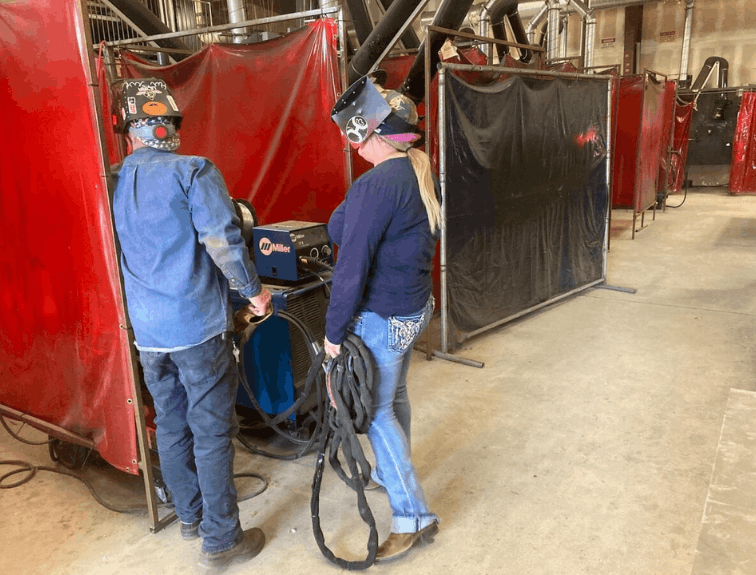
What to expect in hands-on programs
Programs focus on practical application alongside theory. Students learn multiple welding process, including:
- SMAW (stick)
- GMAW (MIG)
- GTAW (TIG)
- FCAW (flux-core)
Many programs also incorporate OSHA safety standards and use virtual reality system like VRTEX to build skills before live welding.
What Jobs Can I Get as a Welder?
Once you earn certifications, welders in California can find opportunities across multiple industries with solid pay scales and room for advancement.
Entry-level welding jobs and average salaries
Entry-level certified welders typically start in positions as:
- Welder
- Fabrication welder
- Welder fitter
- Wirer
The average salary for welders in California is $27.40 per hour, with junior welders earning approximately $19.90 per hour. And senior welders commanding $28.68 per hour. Most first-time welders begin at $20 per hour with comprehensive benefits.
Industries hiring certified welders in California
Certified welders can find work in numerous sectors throughout the state:
- Oil refineries and pipeline construction
- Nuclear power plants and power generation
- Aerospace and manufacturing
- Structural building and bridge construction
- Automotive industry
- Commercial fabricating jobs
The Bureau of Labor Statistics projects that total national employment for welders will exceed 437,000 by 2032.
Advanced roles and specialization options
Experienced welders have several paths for career advancement:
- Certified welding inspector (CWI)
- Quality control inspector
- Welding project manager
- Welding shop supervisor
- Welding sales representative
- Welding shop owner
Specialized welders like “Rig Welders” performing mobile field welding earn between $110,240 to $114,400 annually.
Maintaining certification and continuity logs
Welders must document continuous practice through continuity logs to keep their certification valid. For AWS D1.1 structural steel certification (using SMAQ, FCAW, or GMAW) welders must prove continuous welding without breaks exceeding 6 months. Sheet metal welders certified under AWS D9.1 (using GTAW or GMAW) must document continuous practice without breaks exceeding 12 months.
Failure to maintain continuity requires recertification, costing approximately $500 per process. Most employers and unions maintain records for their welders. Self-employed welders must track their own continuity documentation.
Welding certification offers a practical path to stable, well-paying careers in California. This guide covers the key steps: California relies on industry-recognized certifications like AWS D1.1, ASME IX, and API 1104 rather than state licenses. These certifications prove your skills with specific welding processes and positions.
The certification process starts with a high school diploma or GED. Then you choose between trade schools (as short as 9 months) or a longer apprenticeship. Fast-track programs work well for people ready to start working quickly. You pick your welding process based on your career goals, then pass performance tests at accredited facilities.
The money makes sense. Entry-level positions start around $20 per hour with benefits. Experienced welders with specialized skills earn much more. The industry offers advancement opportunities across oil and gas, aerospace, manufacturing, and construction sectors.
Welding certification opens doors to career stability and growth. The projected national employment exceeding 437,000 welders by 2032 shows strong demand for skilled workers. People considering this career path can expect their training investment to pay off long-term. Welding offers immediate job opportunities plus room for professional growth through additional certifications and specializations.
FAQs
How long does it typically take to become certified welder in California?
The duration can vary, but fast-track programs at trade schools can be completed in as little as 9 months.
Is a state-issued welding license required to work as a welder in California?
No, California does not issue a state welding license. Instead, the state relies on industry-recognized certifications to validate welder skills.
What are the common welding certifications recognized in California?
The three primary welding codes widely recognized in California are:
- AWS D1.1 – for structural steel welding
- ASME Section IX – for pressure vessels
- API 1104 – for oil and gas pipelines
What is the average salary for certified welders in California?
The average salary for entry-level welders in California is $21 an hour with benefits, while experienced professionals can earn significantly more.
How do I maintain my welding certification in California?
To maintain certification validity, welders must document continuous practice through continuity logs. They need to show proof of continuous work without breaks exceeding 6 months.
Apply for Welding Training Now. Fast-track to certification in less than a year.