
IT support remains one of the fastest ways into a technology career that pays well and doesn’t require a four-year degree. A high school diploma plus the right certifications is enough to get hired, and from there the path opens into network administration, cybersecurity, and cloud computing, fields where pay climbs well into six figures. Here’s what the data says about getting started now.
Key Takeaways
- Computer and information technology occupations overall are projected to grow faster than average, adding about 280,000 openings a year through 2035, according to the Bureau of Labor Statistics.
- About 48,700 IT support openings come open every year as people retire or move into other roles, in a field of more than 900,000 workers nationwide.
- Computer network support specialists earn a median of $76,220 a year, well above the overall support specialist median of $62,890.
- Information security analysts, a common next step after IT support, are projected to grow 21% from 2025 to 2035, with a median salary of $129,180.
- A four-year degree is not required. Many computer support specialists qualify with a high school diploma plus IT certifications, according to the BLS.
How Much Demand Is There for IT Support in 2026?
The numbers here are strong for anyone looking to get hired. The Bureau of Labor Statistics projects about 48,700 openings for computer support specialists every year through 2035, all from normal turnover as people retire or move up into other IT roles. In a field this size, that turnover alone creates a steady, dependable stream of entry points for new graduates.
Zoom out and the picture gets even better. Across all computer and information technology occupations, including cybersecurity, cloud computing, and systems administration, the BLS projects growth faster than the average for all U.S. jobs, with roughly 280,000 openings a year through 2035. Some routine helpdesk tasks like password resets are shifting to automated tools, which is part of why the support specialist category itself is projected to hold close to flat rather than expand. That shift is exactly why the entry-level role works best as a launchpad. It gets someone in the door and building real experience fast, before they specialize into one of the roles driving that broader growth.
Will AI Replace IT Support Jobs?
No, and the data on what’s actually growing around IT support backs that up. AI handles the simplest, most repetitive requests now, things like password resets and basic connectivity fixes. That frees up support technicians to spend their time on the problems that actually require a person: troubleshooting that needs judgment, security concerns, and situations where a user needs someone to ask the right follow-up question.
This is exactly why the field is evolving into something better, not disappearing. Industry researchers describe this as a redesign of entry-level IT roles rather than their elimination. The technicians who do well are the ones who understand why a fix works, not just how to follow a script, and that kind of skill is exactly what certification training and hands-on labs are built to develop.
What Does IT Support Actually Pay?
Pay climbs quickly with specialization, and knowing the ladder helps set expectations from day one. Computer user support specialists, the most common entry point, earned a median of $61,860 a year as of May 2025, with top earners clearing $100,540. Computer network support specialists earned more, a median of $76,220, with the highest-paid reaching $127,780.
Industry makes a difference too. Support specialists working in government earned a median of $77,180 in 2025, notably above the field-wide average. Roles in finance and insurance also paid above the median.
The bigger jump comes with specialization, and it’s a fast one. Information security analysts, a natural next step after a few years in support, earned a median of $129,180 in 2025. Network and computer systems administrators earned a median of $99,130. Both roles typically start with the same foundation: a support role, paired with the right certifications.
The Real Career Path: Support Is the Starting Line
The reason IT support works so well as a first move is what comes after it. Help desk and support roles exist everywhere, since every organization with computers needs someone to call when something breaks. That constant, universal demand is what makes it the lowest barrier to entry in tech, and the troubleshooting experience gained there transfers directly into higher-paid specialties.
From there, the paths split toward strong growth. Some technicians move into network administration, maintaining systems instead of just fixing user problems. Others move toward cybersecurity, one of the strongest growth areas in all of technology. Information security analyst jobs are projected to grow 21% between 2025 and 2035, adding more than 40,000 positions nationally, driven by rising cyberattacks and the security demands of AI adoption itself. Cloud computing is another fast-growing lane, as more companies shift infrastructure off physical servers.
The certifications that open these doors build on each other. CompTIA A+ gets a foot in the door for that first support job. Network+ and Security+ point toward the higher-paying specialties from there. This is the structure behind ACI’s IT Professional Training program, which prepares students for A+, Network+, Security+, and Cloud+ certifications in sequence, building toward a career rather than a single job title.
How to Get Started in IT Support
Breaking in is faster and more accessible than most people expect.
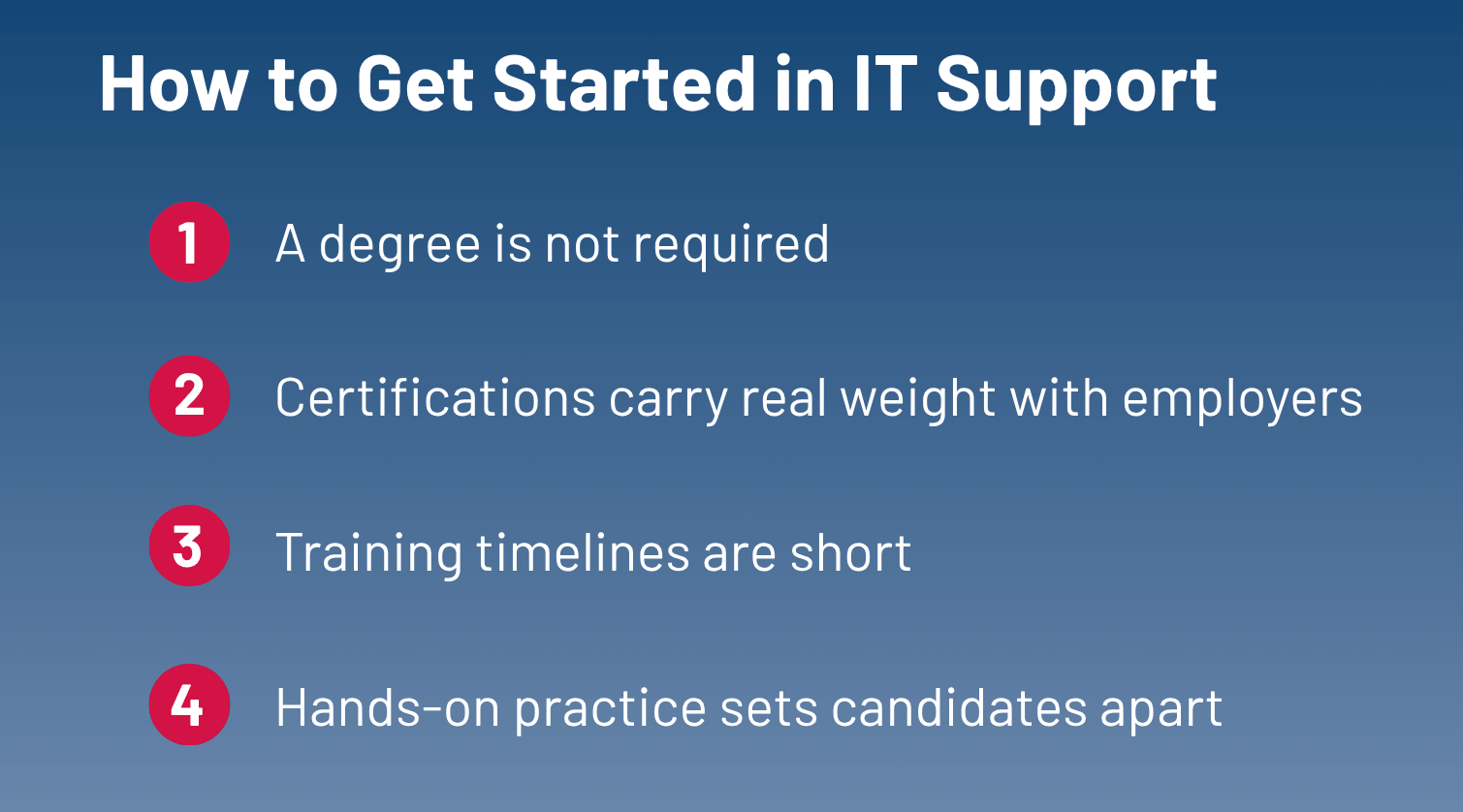
A degree is not required. The BLS confirms that computer user support specialists typically need some college coursework, but candidates can qualify with a high school diploma plus relevant IT certifications.
Certifications carry real weight with employers. CompTIA A+ is the standard entry-level credential, and it shows up in more than 200,000 U.S. job listings each year. It covers hardware, operating systems, networking basics, and troubleshooting, the exact mix of skills a help desk job requires on day one.
Training timelines are short. A focused certification program can be completed in months, not years. ACI’s IT program runs 8 to 12 months depending on the program, fully online, and includes an IT externship for eligible students to build real, hands-on experience before graduating.
Hands-on practice sets candidates apart. Employers increasingly want to see proof of real troubleshooting, not just a passed exam. Even a small portfolio of solved problems from practice labs helps a candidate stand out.
Advanced Career Institute’s IT Professional program, delivered through a partnership with CompTIA, is built around this exact path: A+, Network+, Security+, and Cloud+ certifications, 32 to 48 weeks, fully online for California residents. Tuition assistance is available for students who qualify, and ACI’s job placement team supports graduates as they enter the field.
FAQs
Will AI take over IT support jobs?
No. AI is automating the simplest, most repetitive tasks like password resets, which frees up technicians to focus on the complex troubleshooting and security work that still requires a person.
Do you need a college degree to work in IT support?
No. Many computer support specialists qualify with a high school diploma plus relevant IT certifications, according to the BLS.
What is the difference between IT support and cybersecurity?
IT support focuses on fixing hardware, software, and network problems for users, while cybersecurity focuses on protecting systems from attacks. Cybersecurity roles typically pay more than double the entry-level support median, and support experience is a common stepping stone into them.
Can an IT support job lead to a higher-paying career?
Yes. Many people use support roles to gain hands-on experience before moving into network administration, cybersecurity, or cloud computing, all of which pay significantly more than entry-level help desk work.
What certification should someone earn first for IT support?
CompTIA A+ is the standard starting certification and appears in over 200,000 U.S. job listings a year, making it the strongest first step toward a support role and the specialties beyond it.