

IT Training
Helpful Information About Potential Welding Careers & Trucking Jobs
-

Spot scams, protect accounts, and explore a new career.
October is Cybersecurity Awareness Month. It is a good time for everyone to check how safe their phones, email, and bank accounts really are. Online crime is not just a problem for big companies. In 2025, the FBI received more than 1 million complaints about internet crime, and reported losses topped $20.8 billion. Many of those victims were regular people who clicked a link, answered a call, or trusted the wrong message. This article covers what Cybersecurity Awareness Month is, why it matters for everyday people, which scams to watch for, and simple steps anyone can take to stay safer online.What is Cybersecurity Awareness Month?
Cybersecurity Awareness Month started in 2004. It is led by the National Cybersecurity Alliance and the Cybersecurity and Infrastructure Security Agency (CISA). The goal is to teach people and businesses how to protect themselves online. 2026 marks the campaign's 23rd year. The National Cybersecurity Alliance's theme this year is "Don't Make It Easy for Them." The idea is simple. Small habits, repeated every day, make it harder for criminals to steal money and personal information.Why Cybersecurity Matters for Everyday People
Many people think hackers only go after large companies. In reality, individuals are common targets because they often reuse passwords and trust messages that look real. One stolen password can lead to drained bank accounts, identity theft, and damaged credit. Fixing that damage can take months. The numbers show how common online crime has become. According to the FBI's 2025 Internet Crime Report:- Americans filed 1,008,597 complaints about internet crime.
- Reported losses reached $20.877 billion, up 26% from 2024.
- Phishing and spoofing were the most reported crimes, with 191,561 complaints.
- For the first time, the report tracked scams that used artificial intelligence (AI). Those scams led to 22,364 complaints and about $893 million in losses.
Common Scams to Watch For
Scammers change their methods often, but most attacks fall into a few familiar groups.- Phishing emails and texts. These messages look like they come from a bank, a delivery company, or an employer. They ask the reader to click a link, "verify" an account, or pay a small fee.
- Spoofed phone calls. Caller ID can be faked. A scammer may claim to be from a bank, a government agency, or tech support and ask for account details.
- AI voice and video scams. Criminals can copy a person's voice from short clips posted online. They then call a family member and ask for money in an "emergency."
- Fake job offers. Some job posts are traps. Red flags include requests for bank information before hiring or upfront payments for training or equipment.
- Investment and cryptocurrency scams. These promise fast, "guaranteed" returns. Investment fraud caused the largest losses in the FBI's 2025 report, at about $8.6 billion.
Simple Steps to Stay Safe Online
Good online safety does not require technical skills. A few basic habits block most common attacks.- Use strong, unique passwords. A long passphrase is harder to crack than a short, complex password. Each account should have its own password, and a password manager can keep track of them.
- Turn on multi-factor authentication (MFA). MFA adds a second step, like a code sent to a phone, when someone logs in. Even if a password is stolen, MFA can stop a criminal from getting in.
- Keep devices updated. Software updates often fix security holes. Turning on automatic updates for phones, computers, and apps is one of the easiest ways to stay protected.
- Pause before clicking. When a message seems urgent, it is best to contact the company directly. That means using its official app, website, or the phone number on the back of a card, not the link or number in the message.
- Set a family code word. A shared word that only family members know can help confirm a real emergency call. This simple step can help stop AI voice scams.
- Limit what is shared online. Birthdays, pet names, and hometowns are common security question answers. Keeping social media profiles private makes this information harder to find.
- Length: 32 weeks and 720 clock hours.
- Format: Distance education through the Visalia campus or a hybrid format at the Las Vegas campus.
- Training: Students start with computer and office basics, then move into ethical hacking, security monitoring, digital forensics, and network defense. Hands-on labs take place in safe, isolated environments.
- Certification prep: Coursework aligns with CompTIA Security+, Certified Ethical Hacker (CEH), and Computer Hacking Forensic Investigator (CHFI).
- Real-world experience: Students complete a 135-hour externship before graduating.
-

What the pay, demand, and AI data actually show
IT support remains one of the fastest ways into a technology career that pays well and doesn't require a four-year degree. A high school diploma plus the right certifications is enough to get hired, and from there the path opens into network administration, cybersecurity, and cloud computing, fields where pay climbs well into six figures. Here's what the data says about getting started now. Key Takeaways- Computer and information technology occupations overall are projected to grow faster than average, adding about 280,000 openings a year through 2035, according to the Bureau of Labor Statistics.
- About 48,700 IT support openings come open every year as people retire or move into other roles, in a field of more than 900,000 workers nationwide.
- Computer network support specialists earn a median of $76,220 a year, well above the overall support specialist median of $62,890.
- Information security analysts, a common next step after IT support, are projected to grow 21% from 2025 to 2035, with a median salary of $129,180.
- A four-year degree is not required. Many computer support specialists qualify with a high school diploma plus IT certifications, according to the BLS.
How Much Demand Is There for IT Support in 2026?
The numbers here are strong for anyone looking to get hired. The Bureau of Labor Statistics projects about 48,700 openings for computer support specialists every year through 2035, all from normal turnover as people retire or move up into other IT roles. In a field this size, that turnover alone creates a steady, dependable stream of entry points for new graduates. Zoom out and the picture gets even better. Across all computer and information technology occupations, including cybersecurity, cloud computing, and systems administration, the BLS projects growth faster than the average for all U.S. jobs, with roughly 280,000 openings a year through 2035. Some routine helpdesk tasks like password resets are shifting to automated tools, which is part of why the support specialist category itself is projected to hold close to flat rather than expand. That shift is exactly why the entry-level role works best as a launchpad. It gets someone in the door and building real experience fast, before they specialize into one of the roles driving that broader growth.Will AI Replace IT Support Jobs?
No, and the data on what's actually growing around IT support backs that up. AI handles the simplest, most repetitive requests now, things like password resets and basic connectivity fixes. That frees up support technicians to spend their time on the problems that actually require a person: troubleshooting that needs judgment, security concerns, and situations where a user needs someone to ask the right follow-up question. This is exactly why the field is evolving into something better, not disappearing. Industry researchers describe this as a redesign of entry-level IT roles rather than their elimination. The technicians who do well are the ones who understand why a fix works, not just how to follow a script, and that kind of skill is exactly what certification training and hands-on labs are built to develop.What Does IT Support Actually Pay?
Pay climbs quickly with specialization, and knowing the ladder helps set expectations from day one. Computer user support specialists, the most common entry point, earned a median of $61,860 a year as of May 2025, with top earners clearing $100,540. Computer network support specialists earned more, a median of $76,220, with the highest-paid reaching $127,780. Industry makes a difference too. Support specialists working in government earned a median of $77,180 in 2025, notably above the field-wide average. Roles in finance and insurance also paid above the median. The bigger jump comes with specialization, and it's a fast one. Information security analysts, a natural next step after a few years in support, earned a median of $129,180 in 2025. Network and computer systems administrators earned a median of $99,130. Both roles typically start with the same foundation: a support role, paired with the right certifications.The Real Career Path: Support Is the Starting Line
The reason IT support works so well as a first move is what comes after it. Help desk and support roles exist everywhere, since every organization with computers needs someone to call when something breaks. That constant, universal demand is what makes it the lowest barrier to entry in tech, and the troubleshooting experience gained there transfers directly into higher-paid specialties. From there, the paths split toward strong growth. Some technicians move into network administration, maintaining systems instead of just fixing user problems. Others move toward cybersecurity, one of the strongest growth areas in all of technology. Information security analyst jobs are projected to grow 21% between 2025 and 2035, adding more than 40,000 positions nationally, driven by rising cyberattacks and the security demands of AI adoption itself. Cloud computing is another fast-growing lane, as more companies shift infrastructure off physical servers. The certifications that open these doors build on each other. CompTIA A+ gets a foot in the door for that first support job. Network+ and Security+ point toward the higher-paying specialties from there. This is the structure behind ACI's IT Professional Training program, which prepares students for A+, Network+, Security+, and Cloud+ certifications in sequence, building toward a career rather than a single job title.How to Get Started in IT Support
Breaking in is faster and more accessible than most people expect.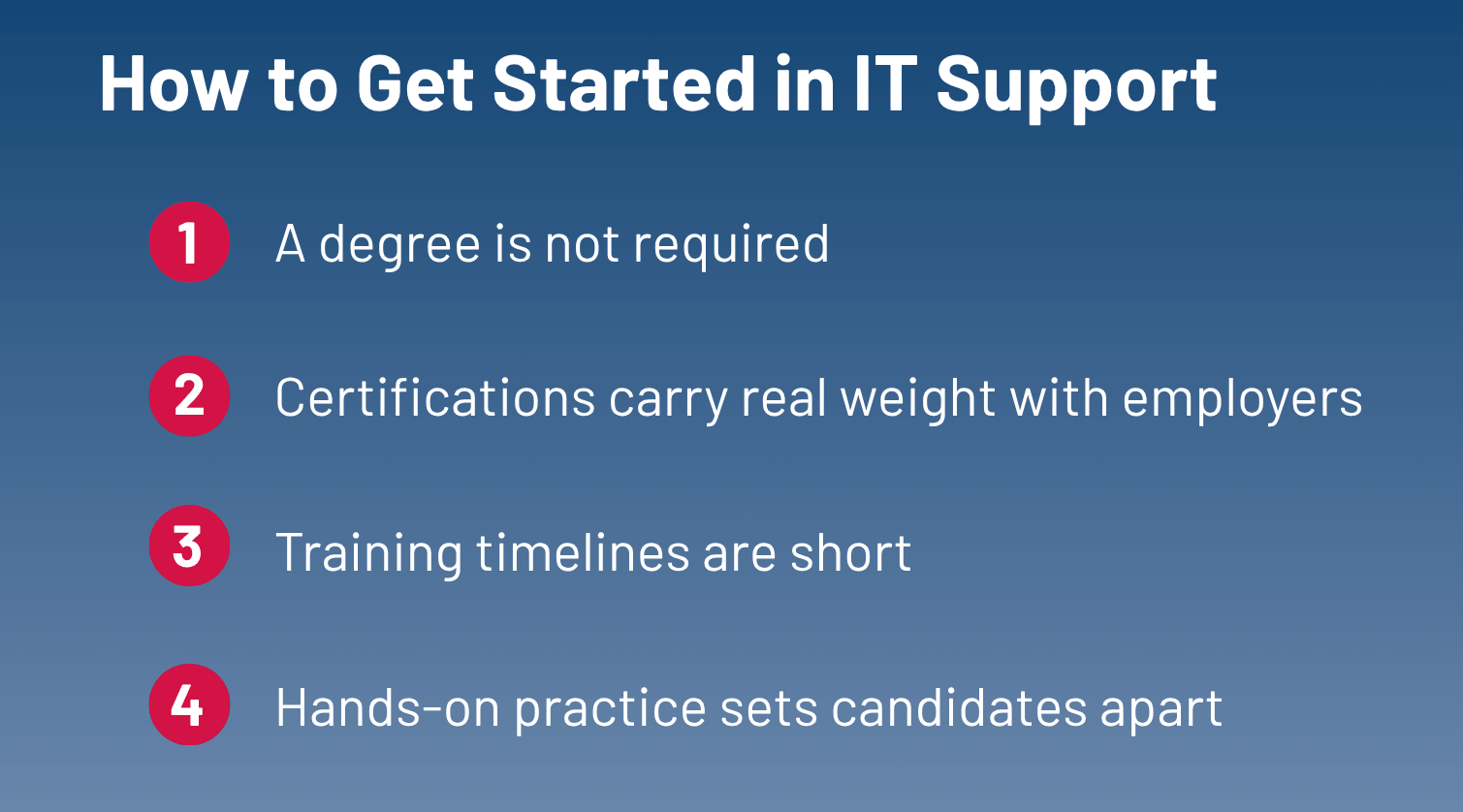 A degree is not required. The BLS confirms that computer user support specialists typically need some college coursework, but candidates can qualify with a high school diploma plus relevant IT certifications.
Certifications carry real weight with employers. CompTIA A+ is the standard entry-level credential, and it shows up in more than 200,000 U.S. job listings each year. It covers hardware, operating systems, networking basics, and troubleshooting, the exact mix of skills a help desk job requires on day one.
Training timelines are short. A focused certification program can be completed in months, not years. ACI's IT program runs 8 to 12 months depending on the program, fully online, and includes an IT externship for eligible students to build real, hands-on experience before graduating.
Hands-on practice sets candidates apart. Employers increasingly want to see proof of real troubleshooting, not just a passed exam. Even a small portfolio of solved problems from practice labs helps a candidate stand out.
Advanced Career Institute's IT Professional program, delivered through a partnership with CompTIA, is built around this exact path: A+, Network+, Security+, and Cloud+ certifications, 32 to 48 weeks, fully online for California residents. Tuition assistance is available for students who qualify, and ACI's job placement team supports graduates as they enter the field.
A degree is not required. The BLS confirms that computer user support specialists typically need some college coursework, but candidates can qualify with a high school diploma plus relevant IT certifications.
Certifications carry real weight with employers. CompTIA A+ is the standard entry-level credential, and it shows up in more than 200,000 U.S. job listings each year. It covers hardware, operating systems, networking basics, and troubleshooting, the exact mix of skills a help desk job requires on day one.
Training timelines are short. A focused certification program can be completed in months, not years. ACI's IT program runs 8 to 12 months depending on the program, fully online, and includes an IT externship for eligible students to build real, hands-on experience before graduating.
Hands-on practice sets candidates apart. Employers increasingly want to see proof of real troubleshooting, not just a passed exam. Even a small portfolio of solved problems from practice labs helps a candidate stand out.
Advanced Career Institute's IT Professional program, delivered through a partnership with CompTIA, is built around this exact path: A+, Network+, Security+, and Cloud+ certifications, 32 to 48 weeks, fully online for California residents. Tuition assistance is available for students who qualify, and ACI's job placement team supports graduates as they enter the field.
FAQs
Will AI take over IT support jobs?
No. AI is automating the simplest, most repetitive tasks like password resets, which frees up technicians to focus on the complex troubleshooting and security work that still requires a person.Do you need a college degree to work in IT support?
No. Many computer support specialists qualify with a high school diploma plus relevant IT certifications, according to the BLS.What is the difference between IT support and cybersecurity?
IT support focuses on fixing hardware, software, and network problems for users, while cybersecurity focuses on protecting systems from attacks. Cybersecurity roles typically pay more than double the entry-level support median, and support experience is a common stepping stone into them.Can an IT support job lead to a higher-paying career?
Yes. Many people use support roles to gain hands-on experience before moving into network administration, cybersecurity, or cloud computing, all of which pay significantly more than entry-level help desk work.What certification should someone earn first for IT support?
CompTIA A+ is the standard starting certification and appears in over 200,000 U.S. job listings a year, making it the strongest first step toward a support role and the specialties beyond it. -

A Complete Career Roadmap
Key Takeaways Getting started in IT support does not take as long as most people think. Here is what matters most for anyone starting out as a help desk technician:- No degree needed to start. People can land entry-level jobs in as little as 3 months through self-study and certifications. Many employers care more about skills than about where a candidate went to school.
- CompTIA A+ is the certification to earn first. This widely recognized credential appears in more than 200,000 U.S. job listings each year and covers the basic skills employers want most.
- The pay is solid from day one. Entry-level positions pay an average of $48,154 a year, and experienced technicians can earn $76,000 or more. The field will add 220,000 new jobs by 2030.
- Hands-on experience matters more than theory. Three documented projects that show real troubleshooting work can put a candidate ahead of people who only have certifications on paper.
- Networking is a real advantage. 85% of jobs are filled through professional connections. Employee referrals are nine times more likely to lead to a job offer than a cold application.
What Does a Help Desk Technician Do?
Help desk technicians answer support requests by phone, email, chat, or in person, then diagnose and fix hardware, software, and network problems.³ Most of the work runs through a ticketing system like ServiceNow or Zendesk, and technicians also set up new technology, document fixes for a knowledge base, and pass tougher issues up to higher-level support. The job leans on a mix of technical and people skills. Troubleshooting shows up in 53% of job postings, communication in 45%, and customer service in 43%.⁴ Working knowledge of Windows, macOS, and Linux is standard, and many listings also call for Active Directory, help desk software, and basic network troubleshooting.⁴ ⁵ Just as important is patience: users often call in frustrated, and staying calm while juggling multiple tickets is a daily part of the role.Educational Pathways to Get Started
There are several ways to break into help desk work, and a four-year college degree is not required for an entry-level job. Some candidates choose to earn a degree instead. Common choices are information technology, computer science, or network administration.⁷ A degree can speed up hiring and sometimes leads to better starting pay, but many employers care more about certifications and hands-on skills, rather than a diploma.¹Formal Degree Options
About 48% of help desk technicians hold a bachelor's degree, and 35% have an associate degree.⁸ Degree programs teach the core knowledge this field needs. Common majors include information technology, computer information systems, and network administration.¹ Coursework often covers PC repair and network management. It also covers:- Operating system setup
- Security
- Desktop troubleshooting
- Customer service
Professional Certificate Programs
Certificate programs work well for people who want focused training without a full degree. Community colleges offer help desk certificates that run 15 to 19 credit hours and are built to prepare students for entry-level support jobs.⁹ ¹⁰ These programs mix online and classroom learning with hands-on practice. Students cover:- Client operating systems
- Hardware installation
- Software setup
- Problem diagnosis
- Computer security.¹⁰
Boot Camps and Training Courses
Boot camps move fast and pack a lot of training into a short time. Live, in-person programs run 3 to 7 days with expert instruction, while self-paced options usually need 15 to 25 hours a week over six months.¹¹ Career-focused programs average 6 to 8 months, though some students finish in as little as seven months.¹² ¹³ These courses include hands-on labs and project work, and they help prepare students for several certifications, including:- CompTIA A+
- Network+
- Security+ ¹²
How Long Does It Take to Become a Help Desk Technician?
The amount of time it takes to become a Help Desk Technician depends on the route you choose to become certified. Once hired, most technicians feel comfortable in the role after 2 to 3 months, and full confidence usually comes together within the first year.¹⁴Key Certifications and Credentials
Certifications give employers a clear picture of what a candidate knows, especially when that person does not have much work history yet. This matters more than most people realize. In fact, 79% of HR professionals at medium and large companies consider industry-recognized certifications when they hire.¹⁵Entry-Level Certifications
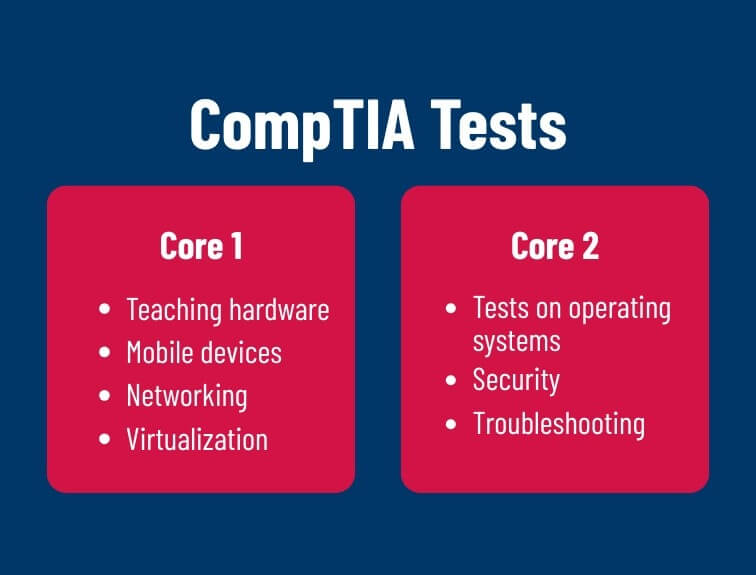
CompTIA A+ is the most recognized starting certification for help desk roles. It is vendor-neutral, which means it works the same way across different employers and industries, not just one company's products. Earning it means passing two exams. One covers hardware and networking basics, and the other covers operating systems, security, and troubleshooting.¹⁶ Together, they prove the core skills employers want most:- PC repair
- Network basics
- Technical support
 The Google IT Support Professional Certificate is another good option. Instead of one exam, students take five courses. The courses cover:
- Technical support basics
- Networking
- Operating systems
- System administration
- Security ¹⁸
Advanced Certifications
After earning an A+, CompTIA Network+ is a natural next step. It proves a person's ability to design, set up, and troubleshoot networks. CompTIA Security+ goes further into threats, weaknesses, and incident response. It is also required for federal contractors and defense-related employers.¹⁹ ITIL (Information Technology Infrastructure Library) Foundation is worth knowing about too. It covers service management practices used by most large companies, including more than 65% of Fortune 500 companies.¹⁹Certification Costs and Study Time
Certification costs vary by exam and by how someone chooses to prepare, generally landing anywhere from a few hundred dollars for the exam itself to $1,000 or more once prep materials or courses are factored in.¹⁷ ²⁰ Study time varies too, and it depends heavily on the training path. Structured programs tend to move faster and more consistently than self-study.²¹A Roadmap to Getting Hired
Technical knowledge opens the door, but landing the job takes more than that. Candidates also need hands-on experience, the right connections, and a smart job search plan.Develop Practical Skills
Hands-on labs are where real learning happens. They build pattern recognition and logical troubleshooting skills. They also build communication under pressure and time management. Employers notice these skills right away. Shadowing skilled coworkers is another good way to pick up new techniques and customer service strategies.²³ Following industry leaders on social media or YouTube can also help candidates stay current on the skills employers want.⁸Build a Portfolio of Projects
Certifications matter, but they only tell part of the story. Hands-on lab work and documented projects are what set a candidate apart from people who only have credentials on paper.²⁴ Aim for three strong projects that show the tools used, how the problem was solved, and what the outcome was.²⁴ Clear, measurable results carry more weight than general descriptions of skills.²⁴Network with IT Professionals
Networking fills 85% of jobs, which makes professional connections one of the biggest advantages in a job search.²⁵ Employee referrals are nine times more likely to lead to a job offer,²⁶ and 70% of successful candidates had an inside connection.²⁶ Joining professional groups and attending industry events puts candidates in front of the right people.Job Search Strategies
Sites like LinkedIn, Indeed, and ZipRecruiter are good places to start looking for entry-level openings.²⁷ Google Career Certificates connect graduates with more than 150 vetted employers.²⁷ Meta certifications connect people with more than 200 companies.²⁷ A resume with the right keywords is more likely to pass the first screening step.²⁷Salary Expectations and Negotiation
Average annual pay sits at $48,154, and most positions pay between $40,000 and $54,000.²⁸ Top earners bring in around $63,000.²⁸ It is best to wait to negotiate until there is a written offer.²⁹ Candidates should research typical pay in the area first.²⁹ They should also look at the whole pay package, since bonuses and benefits matter too.²⁹Conclusion
This guide lays out a full roadmap for starting a help desk career. This path offers several training options, strong pay starting around $48,000, and clear room to grow. Candidates can start with certifications like CompTIA A+ and build hands-on experience through labs and projects. Demand for 220,000 technicians by 2030 means steady job opportunities ahead. Building these skills now can lead to a strong new career in IT.FAQs
What career paths open up after working in help desk?
Common next steps include desktop support and junior systems administrator roles. Other options are network operations center (NOC) engineer or junior network engineer roles. Many technicians move into cybersecurity. Others move into cloud administration or project management.Is help desk technician a stressful job?
It can be during busy stretches, since technicians often juggle several frustrated users at once. Most say the stress becomes manageable once they build a system for prioritizing tickets.What is the difference between a help desk technician and an IT support specialist?
The titles are often used interchangeably. Where they differ, "help desk technician" usually refers to entry-level troubleshooting, while "IT support specialist" often covers broader systems work.Can help desk technicians work remotely?
Yes. Many employers now offer remote or hybrid help desk roles, especially for positions built around ticketing systems and remote-access tools.What is the difference between Tier 1, Tier 2, and Tier 3 help desk support?
Tier 1 handles basic troubleshooting and ticket intake, Tier 2 handles more complex issues, and Tier 3 involves specialized engineers who resolve the hardest problems. Most technicians start at Tier 1 and move up with experience.Is on-the-job training required even after earning a certification?
Yes. Certifications cover the fundamentals, but most employers still train new hires on their specific ticketing systems and internal processes. References[1] - itcareerfinder.com
[2] - advanced.edu/training-programs/it-professional-training
[3] - comptia.org
[4] - franklin.edu
[5] - auxilion.com
[6] - comptia.org/blog
[7] - indeed.com
[8] - coursera.org
[9] - catalog.tacomacc.edu
[10] - catalog.stlcc.edu
[11] - uh.edu
[12] - scitexas.edu
[13] - newtotraining.com
[14] - reddit.com
[15] - comptia.org/blog
[16] - beyondtrust.com
[17] - dsdt.edu
[18] - tcm-sec.com
[19] - linkedin.com
[20] - ituonline.com
[21] - acilearningtechacademy.com
[22] - auxilion.com
[23] - indeed.com
[24] - artempolynko.com
[25] - mobilocard.com
[26] - wowledge.com
[27] - coursera.org
[28] - ziprecruiter.com
[29] - roberthalf.com
[30] - redhat.com
[31] - alphaconsulting.com
-
Bringing IT Certification Training to Students
Advanced Career Institute now offers CompTIA certification training. This is an industry-leading program for IT skills in the technology sector. These courses are offered online for California residents. Designed to encourage more California residents to enter technology careers, our family-owned trade school added these online courses through this partnership to help them get their IT certifications. Advanced Career Institute has brought trade school programs to the Central Valley California and Las Vegas areas for decades. By adding certifications to the school’s hands-on career training programs for students statewide, ACI gives students more valuable training that leads to steady IT careers. The CompTIA IT certification courses provided with ACI give professionals a real path into IT careers, The program covers:- CompTIA A+
- Network+
- Security+
- Cloud+
What You Need to Know
- Advanced Career Institute partners with CompTIA to bring top-tier IT certifications
- Students can study at their own pace online without strict class times
- Technology jobs keep growing, especially in cybersecurity and network support, creating thousands of open positions
What is Advanced Career Institute's New CompTIA Partnership?
The Partnership with CompTIA
Advanced Career Institute recently expanded its training options to include online CompTIA certification courses for California residents. The family-owned trade school, known for its practical approach to CDL and welding training across Central Valley California and Las Vegas, now offers IT certification programs throughout the state of California. This partnership brings CompTIA certification courses directly to students through an online format designed for working adults. For ACI, this partnership marks a significant expansion into the technology sector, adding an online component to their traditional in-person trade programs. Students can now pursue CompTIA’s industry-recognized IT certifications. The flexible online programs allow them to study while managing life commitments, without leaving their current jobs or relocating to attend classes.Who Are the Partners Involved?
Advanced Career Institute partnered with CompTIA, the world’s leading tech association, to deliver these certification courses online. CompTIA has been the standard for IT certifications for over 40 years, with more than 2 million IT professionals certified worldwide. Their certifications are vendor-neutral, meaning they’re recognized across the entire technology industry rather than tied to one specific company. The trade school maintains its focus on practical, results-oriented education while expanding into the technology sector. Students receive the same quality training approach that Advanced Career Institute has delivered for decades in their CDL and welding programs. CompTIA was the natural choice because their certifications open doors to real IT jobs. Employers across industries recognize CompTIA credentials as proof that someone has the skills to do the work.Why This Partnership Matters
This partnership addresses the growing demand for qualified IT professionals across California. Traditional certification training often requires expensive programs with rigid schedules that don't work for people with jobs or family responsibilities. Advanced Career Institute's approach removes these barriers by offering flexible online learning at accessible prices. The partnership fits with Advanced Career Institute's mission of providing practical career training that leads to stable employment. IT professionals with CompTIA certifications can find steady work with room for growth, making these courses a natural addition to their program offerings.What Does This Mean for IT Career Training?
Growing Demand for IT Professionals
The technology sector keeps growing, which means more job openings in cybersecurity, network support, and technical help desk roles. Companies need people with CompTIA certifications, but finding qualified works can be a challenge. The U.S. Bureau of Labor Statistics shows computer support jobs will continue to be a necessity. Cybersecurity positions are growing even faster. This creates real opportunities for people looking to change careers or find stable work with the skills employers actually want.Making Certifications More Accessible
IT certification training used to be expensive, with set schedules that didn't work for working adults. Online CompTIA courses fix these problems. Students can learn from home and study when it works for their schedule. They don't need to quit their jobs or move somewhere else. This helps people in Central Valley California and other areas who couldn't access training before. Working parents and people with other responsibilities can now get certified. Advanced Career Institute's online approach connects students to good-paying tech opportunities without the usual barriers.Conclusion
Advanced Career Institute's new partnership with CompTIA addresses critical needs in California's IT workforce by making professional certifications accessible and affordable. The online format removes traditional obstacles like geographic limitations and inflexible schedules, benefiting working adults and underserved communities. This expansion connects qualified California candidates with thousands of open positions requiring CompTIA credentials and a stable career for the future.FAQs
Are CompTIA courses recognized by employers in the IT industry?
CompTIA certifications are widely recognized by employers across the technology sector. These industry-standard credentials demonstrate proficiency in essential IT skills and are often listed as requirements or preferred qualifications for positions in technical support, network administration, and cybersecurity roles.What IT certification programs are available through Advanced Career Institute?
Advanced Career Institute offers several IT certification training programs including:- CompTIA A+
- CompTIA Network+
- CompTIA Security +
- CompTIA Cloud+
What makes CompTIA certifications valuable for career changers?
CompTIA certifications open doors to stable, high-paying technology careers with strong job growth projections. The IT sector faces a significant gap between available positions and qualified candidates, especially in cybersecurity and network administration, making certified professionals highly sought after by employers.