

Trucking
Helpful Information About Potential Trucking Jobs
-
Common Things Truckers Transport
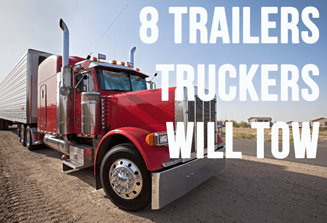
Getting into the trucking industry, you’re going to be driving many different types of trucks and towing different trailers carrying cargo of all types. Truck drivers can find themselves towing everything from food and any sort of goods, to auto parts to entire vehicles to even houses. The trailers required to properly transport those goods vary widely, as you may imagine. Trailers may vary significantly in terms of size and have different requirements and state roadway regulations, giving a wildly different driving experience for the driver. It’s important to know, then, what kind of trailer you’re hitching to your rig. Here are 8 common types of truck trailers that you may, in your time as a truck driver, find yourself driving. The most common trailer is the Standard Freight Trailer. They are used to carry most boxed, crated, and palletized freight. They are the rectangular-shaped trailers that most people associate with semi trucks. Coming in lengths varying from 28’ to 53’ and widths from 96” to 102” and generally are between 12.5’ and 13.5’ in height. While most Standard Freight Trailers have an axle-to-wheel ratio of 2:8, heavy loads use a 3:12 or 4:16 ratio. Refrigerated Truck Trailers (commonly known as “Reefer” trailers) have a cooling unit installed in the trailer, commonly toward the front, and are insulated to transport perishable, refrigerated, or frozen goods. In general, Reefer Truck Trailers come in the same dimensions as a Standard Trailer, with the only real difference being the refrigeration attached to the front, and the fuel tank stored beneath the trailer. Container Skeletal Carriers are designed to transport international cargo containers that can range from 20’ and 45’ in length. Some come in adjustable configurations to accommodate containers of varying sizes. They carry the standard 2:8, 3:12 and 4:16 axle/wheel configurations depending on load weights. Platform, or Flat Bed, Trailers consist of a flatbed trailer with no roof or sides. They are designed to haul oversize cargo that won’t fit inside a standard freight trailer, or for materials that need to be loaded or unloaded from the top or side of the trailer. They run up to 48’ in length and carry a variety of materials. If you are carrying oversized or special cargo similar to a flat bed, you may also use a Platform Drop deck/Gooseneck Trailer. They are used for cargo with special needs with minor differences to flatbed trailers. They have a similar feel to a standard platform trailer, but also include a raised bed, or gooseneck. Car Carrier Trailers are designed to transport cars, trucks, and similar vehicles. They generally have two levels, and a series or ramps designed for the loading and unloading of vehicles. For relatively large, bulky, and light cargo, Deep Drop Furniture/Electronics Trailers are often employed. They feature a lower rear deck to allow a greater cargo capacity capability. As the name suggests, furniture and electronics are often transported in these types of trailers. If you’re working in the logging industry you may find yourself towing a Timber Trailer. Essentially a flatbed trailer equipped with vertical stakes designed to hold logs into place, Timber Trailers are sometimes called “Loggers.” -

The Pros and Cons to Team Driving
Loneliness can be a big drawback to the trucker’s life. The days and even weeks of continuous solitude (outside of short stints at the truck stop, anyway) can get to even the most hardened of loners out on the road. But there is a solution. What about team driving? After all, two bodies are better than one, right? As with any too-good-to-be-true scenario, though, it often IS a little too good to be true. There are certainly many positive and negative aspects to tandem driving, and quelling the loneliness factor is but one of them. PRO: You can drive longer. While there are rules limiting how much team drivers can stay in the truck at any one time without a rest, In general team driving gives a primary advantage of being able to drive for longer periods of time. Federal Motor Carrier Safety Administration (FMCSA) rules dictate a single driver may only run a certain amount of time without rest. Team drivers can switch off driving duties, allowing the truck to continue rolling down the pike to its destination with fewer stops and breaks.
However, beware that this does not mean you get twice as much road time if you have a partner. FMCSA rules have recently been changed, requiring 10 consecutive hours off-duty, and only two of those hours may be spent in the passenger seat of the truck. That means that driver must spend time either out of the truck or in the sleeper berth. However, your driving partner still affords you a significant amount of potentially additional time in the truck.
PRO: You can drive longer. While there are rules limiting how much team drivers can stay in the truck at any one time without a rest, In general team driving gives a primary advantage of being able to drive for longer periods of time. Federal Motor Carrier Safety Administration (FMCSA) rules dictate a single driver may only run a certain amount of time without rest. Team drivers can switch off driving duties, allowing the truck to continue rolling down the pike to its destination with fewer stops and breaks.
However, beware that this does not mean you get twice as much road time if you have a partner. FMCSA rules have recently been changed, requiring 10 consecutive hours off-duty, and only two of those hours may be spent in the passenger seat of the truck. That means that driver must spend time either out of the truck or in the sleeper berth. However, your driving partner still affords you a significant amount of potentially additional time in the truck.
 CON: You have to share the truck with someone else. Probably the single biggest hangup to the team driving setup is the fact that you are sharing your already tight cab with another person. That means you are essentially married to that person: sharing a sleeping space (though hopefully not at the same time) and a living area in a home where neither person can stand up and leave the room. Tiffs and squabbles can become really awkward really quickly, and you have to also be aware of the other person’s feelings and needs as well as your own.
PRO: Team incentives are great. Large trucking companies many times offer team driving incentives such as a sign-on bonus or a 5,000 mile-per-week guarantee, even if the team doesn’t log that many miles. They also frequently enjoy higher per-mile and safety bonus rates, and often get priority dispatch.
CON: You’re still splitting the check. Keep in mind that even though you get more money, you’re still splitting the money you earn, so you will need to calculate how many miles you need to run, and whether that number is realistic and feasible, in order to operate at a profit for both of you.
PRO: You can take your spouse. Husband and wife teams, (or simply spousal pairings, depending on your situation) are relatively common in truck driving tandems. If you don’t have children it can make for a fun and rewarding experience with your significant other, seeing the world and working together…if that is a situation you can live with.
CON: You may be paired up with a stranger. If you don’t have a dedicated partner, you could be assigned on, and who knows how that will work? Being stuck on the road with someone you don’t trust can be a harrowing experience, so partnering with someone you don’t know is a high-risk, high-reward scenario. Approach it with caution.
The bottom line is, if you think you are interested in a team driving setup, do your research first. It can be a highly rewarding situation for you and for your partner, but so too can it very easily fall apart, leaving you potentially holding a very expensive bag.
CON: You have to share the truck with someone else. Probably the single biggest hangup to the team driving setup is the fact that you are sharing your already tight cab with another person. That means you are essentially married to that person: sharing a sleeping space (though hopefully not at the same time) and a living area in a home where neither person can stand up and leave the room. Tiffs and squabbles can become really awkward really quickly, and you have to also be aware of the other person’s feelings and needs as well as your own.
PRO: Team incentives are great. Large trucking companies many times offer team driving incentives such as a sign-on bonus or a 5,000 mile-per-week guarantee, even if the team doesn’t log that many miles. They also frequently enjoy higher per-mile and safety bonus rates, and often get priority dispatch.
CON: You’re still splitting the check. Keep in mind that even though you get more money, you’re still splitting the money you earn, so you will need to calculate how many miles you need to run, and whether that number is realistic and feasible, in order to operate at a profit for both of you.
PRO: You can take your spouse. Husband and wife teams, (or simply spousal pairings, depending on your situation) are relatively common in truck driving tandems. If you don’t have children it can make for a fun and rewarding experience with your significant other, seeing the world and working together…if that is a situation you can live with.
CON: You may be paired up with a stranger. If you don’t have a dedicated partner, you could be assigned on, and who knows how that will work? Being stuck on the road with someone you don’t trust can be a harrowing experience, so partnering with someone you don’t know is a high-risk, high-reward scenario. Approach it with caution.
The bottom line is, if you think you are interested in a team driving setup, do your research first. It can be a highly rewarding situation for you and for your partner, but so too can it very easily fall apart, leaving you potentially holding a very expensive bag. -

How to Get the Most Out of Your Trip
Trip planning may just be the trucker’s best friend. Planning out your route involves more than simply which roads to take; you also have to take into account when and where to stop to eat, refuel, and rest. This is more than simply out of necessity for the hungry, tired driver. It’s a regulation, a government-mandated requirement that must be done at given intervals according to the rules governing hours of service, the trucking company, and it must be tracked by the electronic logbook. Beyond that, poor trip planning can have all sorts of nasty and undesirable consequences. Of course, you can run out of fuel, or fuel at the wrong time (leading to issues with your vehicle weight and negatively affecting your schedule), or end up in a strange or even dangerous place. These things can end up costing you valuable time and money (keeping in mind, for example, that there can be a price difference of up to 10 cents per gallon between states, so be mindful of stopping where fuel prices are cheaper). Remember the inefficiency is the enemy of the truck driver. As you begin planning your route, consider a few things:- Are you tied to your assigned route, or can you seek faster routes? Sometime carriers insist you keep to their routes, while some encourage you to seek out faster routes. However, take caution, though, on finding “shortcuts.” Often they end up more trouble than they’re worth.
- Don’t use 55 mph as your benchmark for travel, even if most of your miles are logged on the freeway. In fact, a blog posted at Smart Trucking suggests calculating trips at 38 mph, which often allows you to integrate stops into your trips. “If stopping for bathroom breaks, eating, fueling, border time crossing, traffic, [and] weather are taken into consideration, you’ll find it fairly accurate,” the blog states.
-
Tire Traction Control and Fuel Economy Research
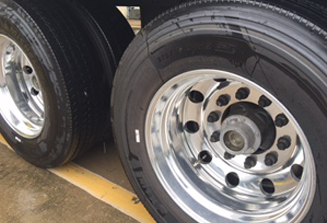
The trucking industry news site Trucking Info has a video feature on their visit to the Goodyear Tires proving grounds in San Angelo, Texas, where they conduct testing on tires, including those designed for tractor trailers. The testing facility sits on 7.000 acres of land, where the company conducts testing on such areas as traction control, fuel economy, and durability. The company provides and quality control on both their own tires and those of competitors. The video breaks down several control tests Goodyear conducts as they continue to develop and improve on their product and develop tires that offer peak performance in a variety of areas, doing their part to make life on the road safer for truck drivers. To view the video and more trucking industry news, visit Trucking Info at this link. -
A World Record Semi Truck Jump of 166 Feet
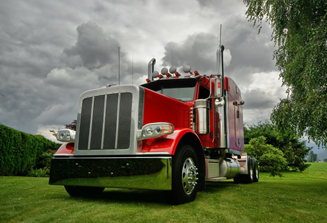
YES, stunt driving semi tractors is a thing. It is always cool to see a driver jumping semi trucks. July 23-25, 2015 was Evel Knievel Days (it’s an extreme sports festival) in his hometown of Butte, Montana. In front of hundreds of cheering onlookers, Gregg Godfrey shattered his 2008 world record by jumping his semi-truck 166 feet in the air. His 2008 record was a 50-foot jump, which was broken in 2014 with a 83.7 foot jump… Oh, and that one just happened to include an attached trailer…. And, just because he could… he ended this world record shattering jump by kindly parallel parking his rig. (which most people can’t pull off on a normal day, with parallel park assist!)World Record Semi Truck Jump! YouTube video by Colton Moore -

Demand for Truckers Continues to Grow
There are many reasons to consider a new career as a professional truck driver. The commercial truck industry plays an important role in the national economy which should give drivers a sense of accomplishment. In a column published by Tire Review, Bob Costello, president of the American Trucking Associations wrote about the important role the trucking sector is playing in today’s economy. “There is no industry more essential to the health and welfare of the U.S. economy than the trucking industry,” Costello wrote. “America’s trucks move the vast majority of America’s freight – from farm to factory to warehouse to retailer to home, trucks dominate freight transportation.” Costello added that “When looking at the industry, it is important to appreciate its size. According to the Department of Transportation, there are more than one million interstate motor carriers – including for-hire, private fleets and owner-operators. And those carriers moved 9.7 billion tons of freight in 2013 – nearly 70 percent of all the tonnage moved by trucks.” With trucks playing such an important role in the national economy, becoming a professional truck driver could be a great way for you to enter a profession that allows you to make a difference and feel good about the work you are doing. “Every grocery store, shopping center, car dealership, bookstore or pharmacy gets their goods via truck,” Costello wrote. “And in today’s on-demand economy, every time a person clicks the checkout button on an online retailer, another bit of freight is put on the back of a truck. Trucking is a $681 billion industry; more than 81 percent of all freight-related dollars were paid to the trucking industry. With more than 3.2 million drivers – and 7 million employees overall – trucking really is the lifeblood of the U.S. economy.” The size and growth of the trucking industry is another reason why this is a great career opportunity. The truck industry continues to grow and there is a need for thousands of more CDL trained commercial truck drivers. In fact, the demand for more drivers is so great that many truck carriers are looking for ways to entice more drivers through higher pay and tuition reimbursement for CDL programs. “Con-way Truckload is rolling out a new tuition reimbursement program to entice new drivers to work for the company after attending a professional driving school,” reports TruckingInfo.com. “The program will contribute up to $4000 to students attending or enrolling in a professional driving school to earn a commercial driver’s license. A full-time position at Con-way will be offered upon graduation and a driver must work for Con-way for a year to receive the full amount.” Demand for trucking services continues to grow across the country. However, truck carriers are struggling to find enough qualified driver to meet that demand and its forcing trucking carriers to look for creative ways to encourage more individuals to consider a career as a commercial truck driver. “Professional truck drivers are essential to our nation’s economy and with the current driver shortage, we’re looking for more ways to help bring new professionals into the industry,” said Bert Johnson, vice president of human resources at Con-way. In its article, TruckingInfo.com reported that “Conway will make monthly payments on a student’s loan for the first 12 months of employment with the company. After the year is up, the rest of the reimbursement will be paid in a lump sum. The new program replaces Con-way’s previous tuition assistance program that gave $2,000 reimbursements.” As truck carriers continue to look for thousands of new truck drivers, now is the perfect time to launch a new trucking career. The CDL training program at Advanced puts students at the top of the list for some of the best truck driving jobs in the country and is helping hundreds of jobseekers launch a new career in one of America’s fastest growing employment fields. The quality of education at Advanced can help many students graduate from the CDL training program with multiple job offers and opportunities. This is a great time to consider a new career as a professional truck driver, especially as the industry continues to grow and truck carriers increase their incentives for new drivers.