
Key Takeaways
California’s welding labor market in 2026 combines strong demand, above-average pay, and multiple training pathways. Here are the core points for anyone weighing this career.
- California employs about 26,060 welders. Their median wage is $58,060 a year, about 8% above the national median of $53,750, according to the latest BLS data (May 2025).
- A wave of retirements is opening 40,300 jobs each year across the country. The average welder is 56 years old, and most welders retire around age 57, per AWS workforce data.
- Experience and specialty training raise pay by a lot. Welder IV workers earn close to $80,000 a year. Welding Inspectors and Engineers can earn $90,000 to $110,000.
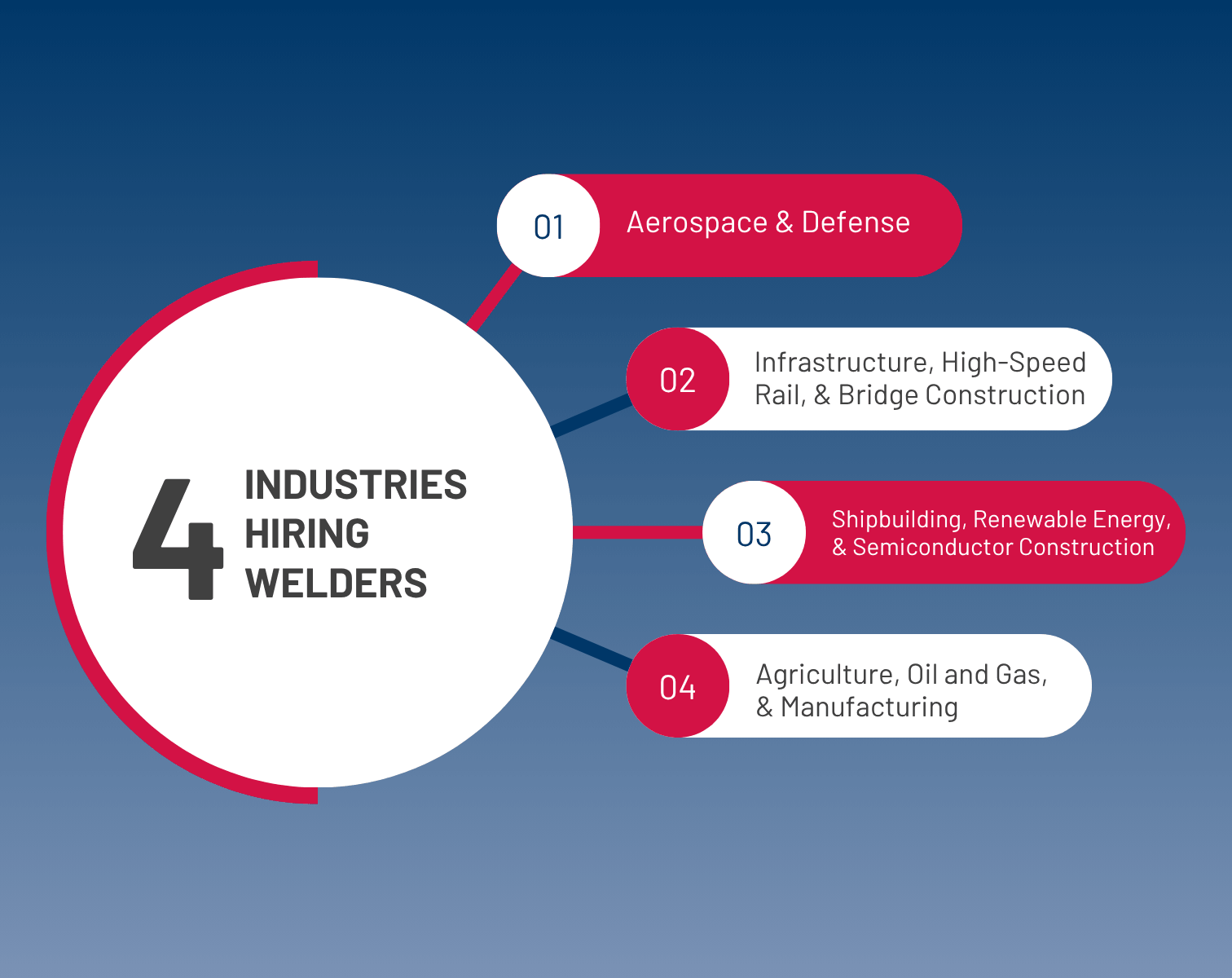
- Aerospace, high-speed rail, and renewable energy are the top hiring fields in California. All three pay above-average wages and offer long-term work.
- Industry and specialization matter as much as experience. Pay can swing by up to 65% between the highest- and lowest-paying fields, and certified inspectors and engineers can earn $90,000 to $110,000.
This data shows a state with pay well above the national average, steady openings even with slow overall growth, and clear routes to higher earnings through specialization.
How Many Welding Jobs Are There in California in 2026?
“Really, what’s being said is we don’t need just more skilled workers. We need an army of skilled workers to do what’s coming.”
— Brian Huff, Owner and CEO, Midwest Technical Institute
California’s welding workforce is bigger than most people think. The 2026 data backs this up. The state ranks among the top employers of welders in the country, and that has not changed.
National Welding Employment and the Retirement Wave
The United States employs about 416,210 welders, cutters, solderers, and brazers, according to the latest BLS data from May 2025 [1]. The wider welding workforce, which includes related jobs, reached about 771,000 people as of 2025, per the American Welding Society [2].
A wave of retirements is pushing demand higher. The average welder in the U.S. is 56 years old, and most welders retire around age 57. That gap, combined with high schools cutting welding programs over the years, has created a shortage.
California’s Share of the Welding Workforce
California employs about 26,060 welders, one of the largest welding markets in the country, behind Texas [1]. The Los Angeles-Long Beach-Anaheim metro area reports a median welder wage of $56,160 a year [1].
Why Annual Openings Outpace the Slow Growth Rate
The BLS expects welding jobs to grow just 2% from 2025 to 2035, which is slower than average [3]. But that number alone does not tell the full story. About 40,300 welding jobs open up each year, mostly from retirements and workers leaving the field [3]. The AWS projects 320,500 total openings in the years ahead [2].
Job counts are only part of the story. Pay matters just as much.
What Do Welders Earn in California Compared to the National Average?
Pay is one of the most useful things to know before choosing this career. The gap between national wages and California’s numbers is big enough to change how someone weighs this path.
National Median Salary vs. California Salary by Metro Area
The national median salary for welders is $53,750 a year, based on the latest BLS data from May 2025 [1]. California’s median annual wage is $58,060, about 8% above the national figure [1]. U.S. News reported a 2024 median of $51,000, which shows how fast pay has climbed in just one year [4].
Welders in the San Francisco-Oakland-Fremont metro area earn a median of $64,320 a year. Welders in the Los Angeles area earn a median of $56,160 [1].
Salary by Experience Level: Welder I Through Welder IV
Experience raises pay by a lot in California, according to August 2026 estimates. Top earners at the Welder II level make $72,866 a year [5]. Welder IV workers earn a fair amount more.
| Level | Experience | Avg. Annual Salary |
|---|---|---|
| Welder I | 0-1 years | $49,998 |
| Welder II | 1-3 years | $61,839 |
| Welder III | 3-5 years | $69,756 |
| Welder IV | 5-7 years | $79,567 |
How Specializations Affect Pay
The industry a welder works, as well as the welding certifications they earn, in can change pay by as much as 65% between the highest- and lowest-paying fields [6]. Aerospace and defense, energy and utilities, and software and networking companies pay 10% to 20% above average [5]. Certified Welding Inspectors (CWI) earn $70,000 to $90,000 a year, and senior inspectors in aerospace or oil and gas can earn more than $95,000 [7]. Senior welding engineers earn $110,000 or more [8].
California Cost of Living and What Higher Wages Actually Mean
California’s higher wages need to be weighed against its cost of living. A Welder I earning $49,998 in California takes home about the same as a Welder I in Washington, D.C., who earns $50,188 [6]. Anyone weighing this career should compare regional pay to local housing and transportation costs. This matters most in the Central Valley, where living costs are lower than coastal cities but welding jobs stay strong.
Certain California industries pay welders more than the average numbers suggest. The industry matters as much as the paycheck itself.
Which California Industries Are Hiring Welders in 2026?
California’s economy covers many industries, and that mix is one reason welder demand here looks different from most other states.
Aerospace and Defense in Southern California
Fabrication shops in Southern California look for welders skilled in GMAW (MIG) and GTAW (TIG) welding. They work with steel, stainless steel, aluminum, and titanium. Many of these jobs require International Traffic in Arms Regulations (ITAR) compliance and experience with aerospace processes [9]. Aerospace and defense jobs pay about 10% above the average welder wage [5].
Infrastructure, High-Speed Rail, and Bridge Construction
California’s high-speed rail project has created more than 19,000 jobs in the Central Valley. It keeps demand steady for steel workers, iron workers, and welders [10]. The City of Long Beach, for example, is hiring pipeline welders at $36.08 to $49.03 an hour, and the job requires special certifications [11].
Shipbuilding, Renewable Energy, and Semiconductor Construction
Port operations along California’s coast keep demand steady for structural and pipe welders. Renewable energy projects and new semiconductor factories are creating welding jobs that few other states can match.
Agriculture, Oil and Gas, and Manufacturing in the Central Valley
The Central Valley includes Fresno, Visalia, and Bakersfield. It mixes agriculture, oil and gas, and manufacturing into one regional economy, and welding skills cross all three industries here. That mix keeps demand steady across sectors rather than tied to any single employer type.
How 2026 Tariffs Affect California Welding Shops
New tariffs on steel and aluminum in 2026 are changing material costs for fabrication shops across the state. Welders and shop owners should plan for these added costs, especially on fixed-price contracts.
Knowing which industries are hiring helps explain not just where the jobs are, but where the better pay is. That difference becomes even clearer when looking at how pay grows over the course of a welder’s career.
Career Growth and Specialization Options for California Welders
A welding certificate qualifies graduates for entry-level jobs. Specialty skills are what separate entry-level pay from the top of the pay scale.
Entry-Level to Senior Welder
The jump from Welder I at $49,998 to Welder IV at $79,567 is a 59% pay increase over about 5 to 7 years [6]. Certifications and specialty training speed up that jump.
High-Paying Paths
Welding Inspectors (CWI) start at $50,000 to $65,000, and experienced inspectors can earn $90,000 or more [7]. Welding Engineers start at $65,000 to $80,000, and senior roles reach $110,000 or higher [8]. Robotic welding is a growing field as more manufacturers automate their production lines.
The ceiling for welding careers is higher than most people expect, and the pay data backs it up at every stage, from entry-level shop work to inspection, engineering, and ownership. For welders in California weighing where to start, Advanced Career Institute’s welding program is worth a look, with campuses in Visalia, Fresno, and Bakersfield.
FAQs
Does welding pay well in California?
Yes. California’s median annual wage for welders is $58,060, about 8% above the national median of $53,750. Pay climbs fast with experience, reaching $79,567 for Welder IV and $70,000 to $90,000 for Certified Welding Inspectors.
Is welding growing or declining?
Welding jobs are projected to grow just 2% from 2025 to 2035, but about 40,300 openings appear each year nationally due to retirements. Demand stays strong even though the growth rate looks modest.
Why are there thousands of welding job openings each year if job growth is only 2%?
Most of those openings come from retirements, not new positions. The average welder is 56 years old, and about 40,300 jobs open up nationally each year as the current workforce ages out.
How long does it take to go from entry-level to top pay as a welder in California?
Most welders move from Welder I to Welder IV in about 5 to 7 years, a jump from $49,998 to $79,567. Certifications and specialty training can speed that timeline up.
Does the industry a welder works in change how much they can earn?
Yes. Pay can swing by up to 65% between the highest- and lowest-paying industries, with aerospace, defense, and infrastructure work paying well above average.
What career paths lead to the highest welding salaries?
Certified Welding Inspectors earn $70,000 to $90,000, senior welding engineers earn $110,000 or more, and some welders open their own fabrication shops. Business ownership and technical specialization pay the most over time.
References
[1] – https://www.bls.gov/oes/current/oes514121.htm
[2] – https://weldingworkforcedata.com/
[3] – https://www.bls.gov/ooh/production/welders-cutters-solderers-and-brazers.htm
[4] – https://careers.usnews.com/best-jobs/welder/salary
[5] – https://www.salary.com/research/salary/benchmark/welder-ii-salary/ca
[6] – https://www.salary.com/research/salary/benchmark/welder-i-salary/ca
[7] – https://www.aws.org/career-resources/career-paths-in-welding/welding-inspector/
[8] – https://www.aws.org/career-resources/career-paths-in-welding/welding-engineer/
[9] – https://www.indeed.com/q-aerospace-welding-l-orange-county,-ca-jobs.html
[10] – https://hsr.ca.gov/work-with-us/jobs/
[11] – https://www.governmentjobs.com/careers/longbeach/jobs/5378854/pipeline-welder-layout-fitter